

Polymeric components, protective coatings, automotive textiles, and exterior building products experience continuous photolytic and photo-oxidative degradation under terrestrial sunlight. Ultraviolet radiation initiates polymer chain scission, while visible light and infrared radiation drive thermal degradation and thermal expansion stresses. To prevent premature field failure and quantify service life, research and quality assurance laboratories rely on xenon testing.
Xenon arc testing remains the industry standard for simulating natural sunlight exposure. Unlike fluorescent UV devices that reproduce only short-wavelength ultraviolet light, a filtered xenon arc lamp provides the closest laboratory simulation of the full solar spectrum, spanning the critical ultraviolet (UV), visible (VIS), and infrared (IR) ranges from 290 nm to 3000 nm.
The Photochemistry Behind Xenon Testing
Material breakdown under ambient outdoor exposure is rarely driven by a single environmental factor. Rather, degradation represents a synergistic reaction involving three primary stressors: light energy, thermal load, and moisture.
1. Spectral Distribution and Optical Filtration
An unfiltered xenon burner emits substantial excess energy in both the extreme UV region (below 290 nm) and the infrared region (around 800–1000 nm). Because terrestrial sunlight at sea level has a natural cut-on wavelength around 290 nm, unfiltered xenon light induces uncharacteristic chemical reactions that never occur in real-world conditions.
To match specific service environments, optical filters adjust the raw spectral power distribution (SPD):
- Daylight Filters: Modify the xenon output to replicate direct outdoor sunlight. These filters are specified in foundational test methods such as ASTM G155 (Cycle 1) and ISO 4892-2 (Method A).
- Window Glass Filters: Attenuate short-wavelength UV light below 310–320 nm to simulate sunlight filtered through window glass. This setup is mandatory for evaluating interior automotive trim (SAE J2412), architectural furnishings, and consumer packaging.
- Extended UV Filters: Allow slightly lower cut-on wavelengths (approx. 270–280 nm) for demanding automotive OEM or aerospace qualification protocols.
2. The Synergy of Thermal Load and Moisture
Photochemical degradation rates increase exponentially as surface temperature rises, following the Arrhenius relationship. Elevated surface temperatures accelerate free-radical propagation and mechanical plasticizer migration.
Moisture triggers physical and chemical degradation through direct hydrolysis, mechanical micro-cracking from thermal shock, and polymer swelling. Modern xenon testing reproduces moisture through programmed water spray cycles, humidity controls (20% to 98% RH), and dark condensation cycles.
Key Control Parameters: Achieving Reproducibility
Achieving repeatable test results across different laboratory runs requires closed-loop control of critical environmental metrics within the chamber.
Narrowband vs. Broadband Irradiance Control
Irradiance represents the rate at which light energy falls onto the test plane. Standard protocols mandate constant irradiance monitoring using closed-loop radiometer control at specific reference wavelengths:
- 340 nm Narrowband: Controls the critical UV region that causes polymer yellowing, chalking, and embrittlement. Standard settings typically range from 0.35 to 0.55 W/(m²·nm).
- 420 nm Narrowband: Monitors the long-wavelength UV and short-wavelength visible boundary. This setting is standard for evaluating color fading and dye migration in textiles and interior plastics.
- 300–400 nm Broadband: Monitors total UV flux (typically 35 to 60 W/m²), balancing broad photochemical exposure.
Thermal Monitoring: BST vs. BPT
Specimen surface temperatures run significantly higher than ambient chamber air temperatures due to radiative infrared absorption. Xenon arc chambers monitor this condition using specialized sensor plates:
- Black Standard Thermometer (BST): Features an insulated stainless steel plate coated with a heat-resistant black layer, reflecting the upper thermal limit of low-conductivity dark materials.
- Black Panel Thermometer (BPT): An uninsulated metal plate representing intermediate thermal conditions.
Maintaining a set black panel temperature (e.g., 63°C ± 3°C or 70°C ± 2°C) while separately controlling Chamber Air Temperature (CAT) prevents divergent testing artifacts.
Global Standards Governing Xenon Testing
Engineers design durability testing matrices around recognized international standards to ensure contractual and regulatory compliance across global supply chains:
- ASTM G155: Standard Practice for Operating Xenon Arc Light Apparatus for Exposure of Non-Metallic Materials. Establishes baseline test cycles for coatings, plastics, and structural sealants.
- ISO 4892-2: Plastics — Methods of exposure to laboratory light sources — Part 2: Xenon-arc lamps. Defines spectral performance, black standard temperatures, and moisture cycling for polymer durability.
- SAE J2527 & SAE J2412: Performance-based automotive standards for exterior and interior automotive components, utilizing performance-specified irradiance and cycle switching.
- IEC 61215: Terrestrial photovoltaic (PV) modules design qualification. Mandates UV and xenon testing to confirm that EVA encapsulation and polymeric backsheets resist yellowing and delamination over decades of operational life.
Chamber Architecture: Engineering the Test Environment
When implementing accelerated testing in an engineering workflow, selecting the proper chamber platform impacts specimen capacity, irradiance distribution, and thermal accuracy.
Chamber Dynamics and Rotating Racks
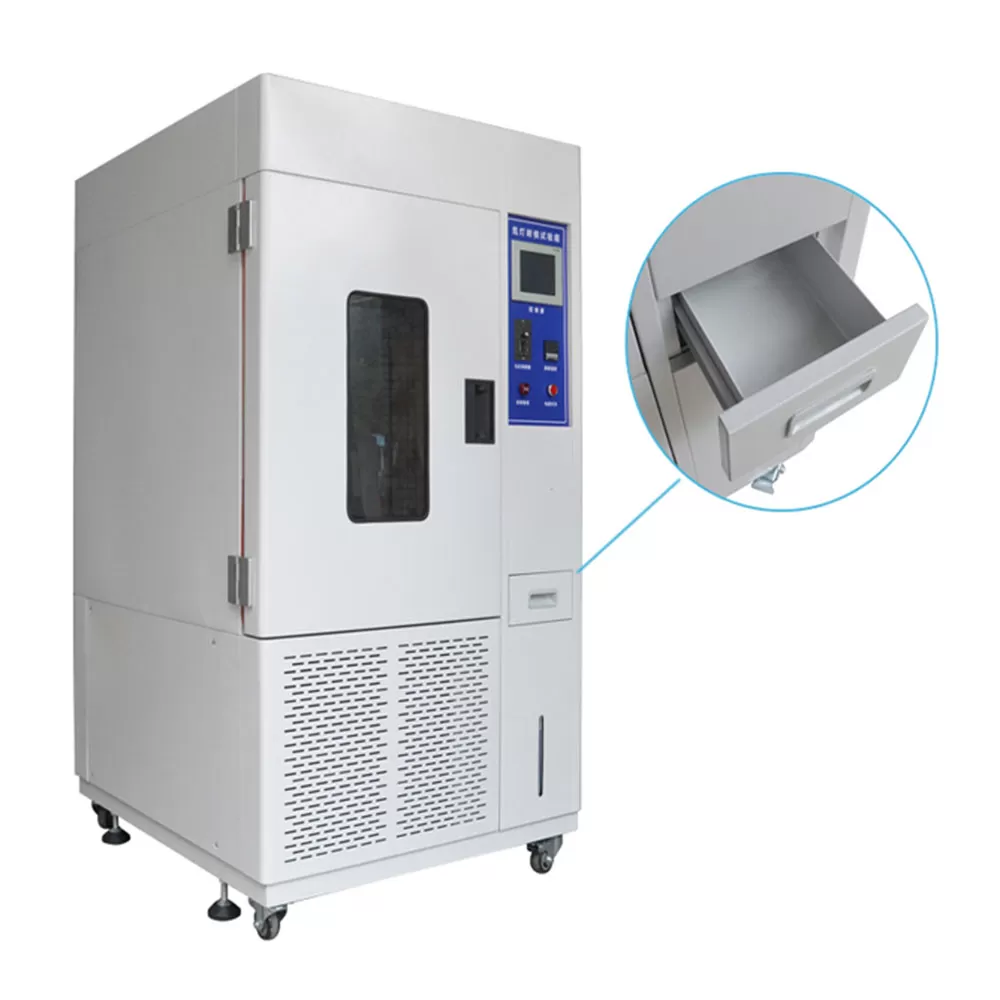
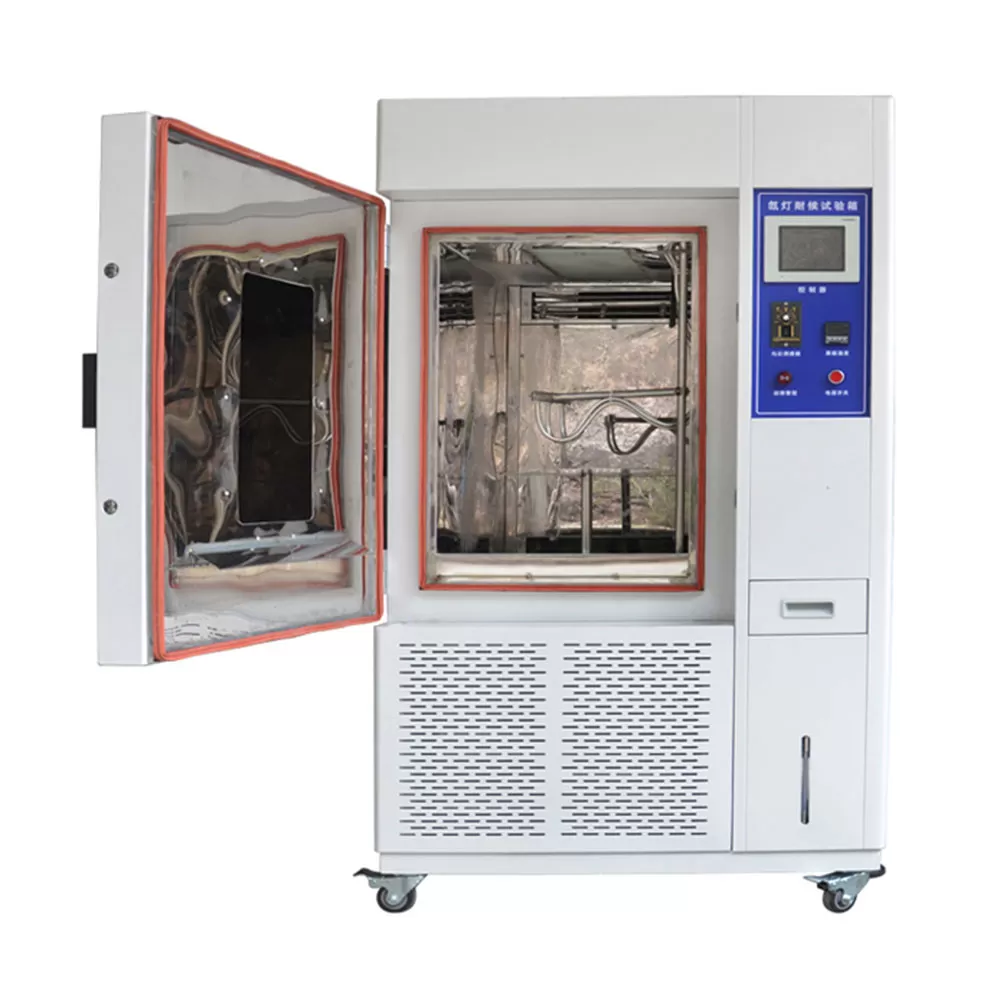
In high-precision xenon testing, non-uniform exposure causes false pass/fail conclusions. High-performance chambers mitigate this through dynamic exposure geometries. Equipment such as the HAOEN HE-XD Series utilizes a 360-degree rotating specimen carousel that turns around a centrally located xenon burner. This rotating configuration eliminates hot spots and ensures every sample receives uniform spectral irradiance and temperature distribution throughout prolonged testing cycles.
In contrast, flatbed (static) chambers position lamps above stationary horizontal trays. While static chambers accommodate three-dimensional, irregularly shaped components, rotating carousel systems deliver superior specimen-to-specimen uniformity for flat panels and standard coupon specimens.
Cooling Architectures: Air-Cooled vs. Water-Cooled Lamps
- Air-Cooled Systems: Circulate conditioned air through the lamp housing to maintain burner temperature. These systems simplify regular maintenance, lower total power consumption, and provide reliable service for small-to-medium test volumes.
- Water-Cooled Systems: Circulate ultra-pure, deionized water directly through a specialized quartz jacket surrounding the xenon burner. Water cooling allows for higher burner wattage and higher irradiance outputs, making it ideal for high-throughput qualification laboratories.
Chamber Capacities and Technical Specifications
Industrial testing chambers balance internal working volumes against facility capabilities. Below is an engineering overview of standard chamber configurations provided by HAOEN:
| Parameter | HAOEN HE-XD-150 | HAOEN HE-XD-225 | HAOEN HE-XD-408 |
|---|---|---|---|
| Internal Capacity | 150 Liters | 225 Liters | 408 Liters |
| Internal Dimensions (W×D×H) | 500 × 500 × 600 mm | 600 × 500 × 750 mm | 800 × 600 × 850 mm |
| Temperature Range | 0°C to 80°C (±0.5°C) | 0°C to 80°C (±0.5°C) | 0°C to 80°C (±0.5°C) |
| Relative Humidity Range | 20% to 98% RH | 20% to 98% RH | 20% to 98% RH |
| Spectral Wavelength | 290 nm – 800 nm | 290 nm – 800 nm | 290 nm – 800 nm |
| Irradiance Range (340nm) | 0.30 – 0.57 W/m² (Adjustable) | 0.30 – 0.57 W/m² (Adjustable) | 0.30 – 0.57 W/m² (Adjustable) |
| Irradiance Range (300–400nm) | 35 – 68 W/m² (Adjustable) | 35 – 68 W/m² (Adjustable) | 35 – 68 W/m² (Adjustable) |
Specimen Preparation, Run Execution, and Post-Test Metrology
Executing an accelerated weathering protocol requires disciplined lab management to avoid user-induced variance.
1. Specimen Preparation and Mounting
- Clean all sample substrates to remove residual surface oils, dust, and mold release agents.
- Label specimens on the unexposed rear surface using thermal- and light-resistant markers.
- Mount specimens without structural strain to prevent mechanical pre-stress from distorting weathering behavior.
- Cover unused fixture ports with anodized aluminum blanks to maintain internal airflow dynamics and light reflection symmetry.
2. Post-Exposure Analytical Metrology
Material degradation spans both microstructural breakdown and macroscopic cosmetic changes. Standard evaluation methods include:
- Spectrophotometric Color Analysis (ASTM D2244): Calculates delta E (ΔE*ab) coordinates using a CIELAB color space to quantify color shift, yellowing (YI), and fading.
- Specular Gloss Retention (ASTM D523): Measures 20°, 60°, and 85° gloss retention to detect surface micro-pitting, micro-cracking, and resin loss.
- Mechanical Integrity Testing (ISO 527 / ASTM D638): Measures loss of tensile strength, elongation at break, and Charpy/Izod impact
resistance to identify bulk polymer degradation.
Frequently Asked Questions (FAQ)
Can laboratory xenon testing hours directly convert into real-world years?
No universal, fixed conversion factor exists. Sunlight exposure, ambient temperature, atmospheric pollutants, and moisture vary widely by geographic location (e.g., South Florida versus central Europe). Accelerated testing establishes relative comparative durability against known benchmark controls rather than precise calendar life.
When should test engineers specify 340 nm versus 420 nm irradiance control?
Choose 340 nm when testing exterior polymers, architectural coatings, and composites where short-wave UV cut-on causes mechanical embrittlement, matrix cracking, and yellowing. Choose 420 nm for indoor components, textiles, dyes, and inks, where visible blue and long-wave UVA light cause chromatic fading and pigment degradation.
How often should xenon arc lamps and optical filters be replaced?
Xenon arc burners degrade over time; while closed-loop control increases power to maintain setpoint irradiance, the lamp will eventually reach its voltage ceiling. Most air-cooled burners offer a rated service life between 1,500 and 2,000 operational hours. Optical glass filters also degrade from solarization, gradually shifting their cut-on point, and must be inspected and replaced per manufacturer schedules.
Why is deionized water required for chamber spray cycles?
Spray cycles simulate natural rain and moisture. Untreated tap water contains dissolved minerals (calcium, magnesium, silica) that evaporate on hot sample surfaces, leaving behind chalky calcification deposits. These deposits mask true degradation and can mechanically scratch surfaces, invalidating optical and gloss measurements.
What is the difference between xenon testing and fluorescent UV testing (QUV)?
Fluorescent UV chambers simulate only the aggressive short-wavelength UV band (UVB-313 or UVA-340) and are used primarily for aggressive screening of durable polymers. Xenon testing reproduces the complete solar spectrum (UV, visible, and infrared), making it essential for products where thermal loading, color change, fading, and optical distortion must be evaluated together.
Upgrade Your Material Durability Testing with HAOEN
Precise climatic control, calibrated irradiance, and dependable chamber stability ensure your products meet global compliance standards before market entry. HAOEN manufactures advanced environmental test equipment, including precision-engineered xenon arc test chambers built to support ISO, ASTM, SAE, and IEC test procedures.
Contact our application engineering team today to review your test specifications, select the right chamber configuration, and request a detailed technical quotation.