

Global battery regulations are tightening faster than ever. As electric vehicles and grid-scale energy storage systems expand, international safety watchdogs demand rigorous verification before any cell touches the market. Engineering teams must adapt to stringent testing criteria, tighter measurement tolerances, and uncompromised audit trails.
For research laboratories and quality assurance managers, obsolete hardware creates costly bottlenecks. Outdated testers miss microscopic voltage anomalies, report skewed capacity measurements, and fail international certification audits. Meeting these demands requires an industrial-grade battery testing device designed for high repeatability and traceable accuracy.
Whether you need to upgrade an existing cell laboratory or scale up pack validation lines, HAOEN delivers dependable, high-precision test instrumentation engineered around current global test standards. Contact our engineering specialists today to request technical datasheets or discuss your laboratory equipment requirements.
1. The 2026 Compliance Environment: Why High Precision Is Mandatory
The regulatory environment for electrochemical storage has shifted from passive safety checks to active, lifecycle-wide performance validation. The European Union Battery Regulation now mandates strict carbon footprint declarations, state-of-health tracking, and performance durability criteria. Meanwhile, North American fire codes enforce aggressive thermal runaway assessments for commercial installations.
These shifting standards leave no room for measurement drift. If your battery test equipment lacks adequate current or voltage accuracy, subtle signs of internal degradation slip through unnoticed. A slight reading error can mask micro-dendrite formation or premature phase changes inside an experimental chemistry.
High-precision testing serves as your first line of defense against certification failures. Detecting internal short circuits before catastrophic failure requires sub-millivolt accuracy and rapid sampling rates. Inaccurate baseline data forces re-testing, burns through prototype budgets, and delays product launches by months.
2. Core Compliance Standards: Technical Equipment Requirements
Certification bodies such as TÜV, UL, and SGS do not simply examine your battery pack; they inspect the validity of your raw test logs. Your test bench must execute automated stress sequences and record dynamic responses without human intervention.
IEC Standards: IEC 62133-2 and IEC 62619
IEC 62133-2 governs portable secondary lithium cells, focusing on electrical misuse, forced discharge, and external short circuits. To satisfy these protocols, your battery compliance testing device must deliver:
- Fast response times to capture peak short-circuit currents without damaging the measurement shunts.
- Continuous high-rate sampling during forced discharge cycles to identify early voltage drops.
- Tight thermal logging integration to cross-reference surface temperature spikes against charging curves.
For industrial applications, IEC 62619 steps up the electrical stress requirements. Industrial battery packs require high-power charge-discharge cycling to assess overcharge and over-temperature control circuits. The test system must safely interrupt massive DC currents within milliseconds when protection thresholds trip.
UL Standards: UL 1642, UL 1973, and UL 9540A
UL 1642 monitors consumer cell stability, enforcing overcharge and short-circuit tolerances with zero margin for error. Equipment drift during prolonged continuous-current charging can cause premature plating, ruining test validity.
For commercial storage, UL 1973 mandates extensive electrical abuse evaluations. Your high-precision battery cycler must log cell voltages across dozens of channels simultaneously to confirm that the internal Battery Management System (BMS) balances cells under extreme thermal loads.
UL 9540A represents the toughest thermal runaway propagation standard in North America. Specialized UL 9540A test equipment must integrate:
- Multi-channel high-speed thermocouple inputs logging alongside electrical parameters.
- Seamless trigger signals between electrical cyclers, thermal abuse chambers, and gas sampling systems.
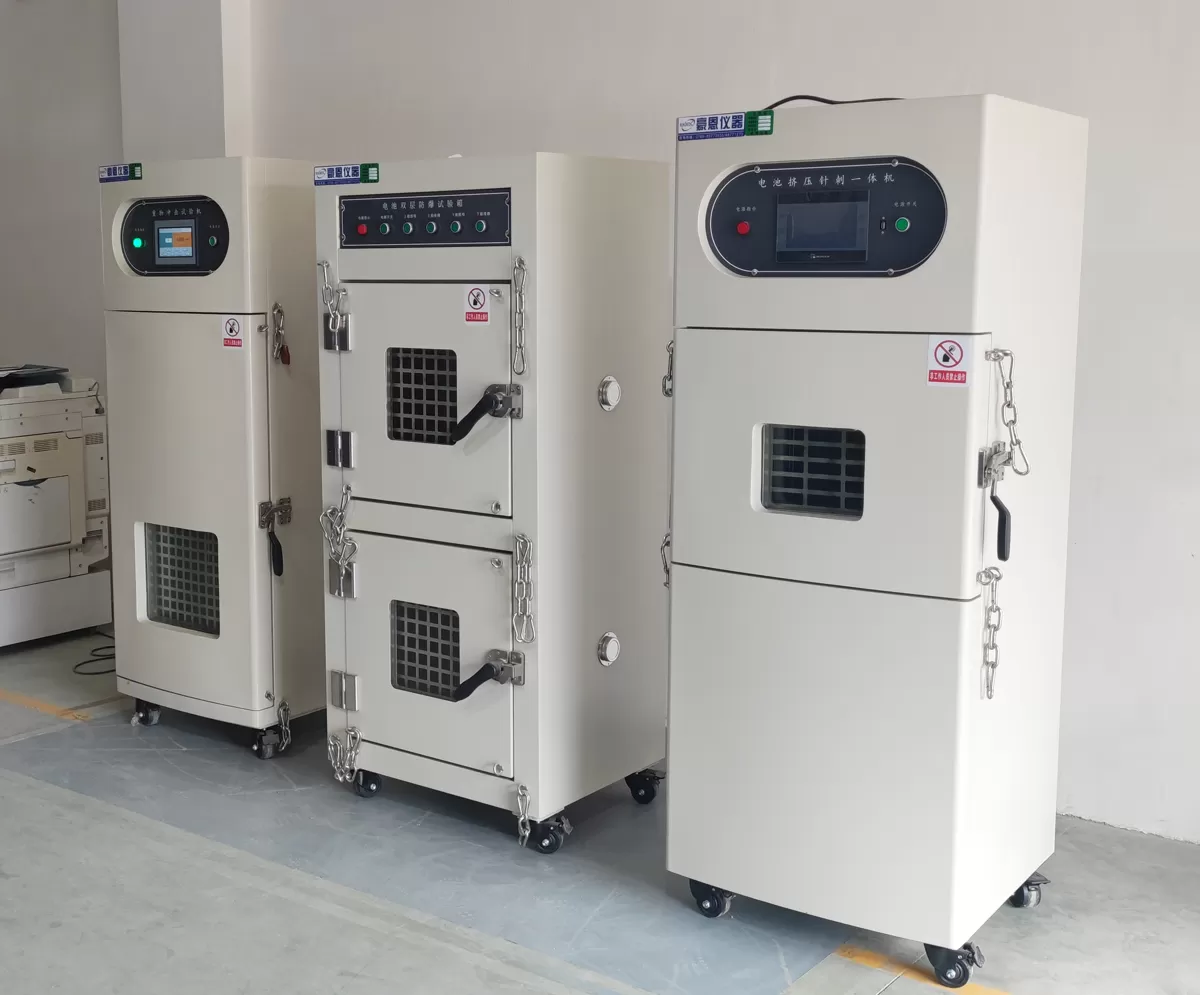
- Explosion-proof safety enclosures designed to contain violent venting events during forced overcharge.
3. Technical Specifications for Equipment Selection
Selecting the right battery charge discharge test system requires evaluating core electrical metrics rather than surface-level software features. Build your lab around verifiable hardware parameters.
Measurement Accuracy and Thermal Drift
Laboratory equipment must maintain high accuracy across full-scale ranges. Aim for voltage and current measurement accuracy within 0.01% to 0.05% of Full Scale (F.S.). Temperature drift coefficients must remain below 10-20 ppm/°C. Without temperature-compensated internal reference circuits, ambient lab temperature swings will distort your coulombic efficiency calculations.
Dynamic Response and Microsecond Sampling
Modern electric vehicle driving cycles, such as WLTP, US06, or dynamic power profiles for grid frequency regulation, involve rapid current switching. The test hardware must switch from high-rate discharge to regenerative charge within microseconds.
A capable EV battery pack testing system must offer data acquisition rates of 1 kHz or higher. This fast sampling captures transient voltage drops caused by internal impedance, helping engineers pinpoint exact degradation mechanisms.
Impedance and BMS Communication Integration
Running separate tests for capacity and impedance wastes time. Advanced test stations integrate broad-bandwidth Electrochemical Impedance Spectroscopy (EIS) directly onto the cycling channels. This setup tracks solid electrolyte interphase (SEI) growth in real time without moving cells between benches.
Pack testing also requires native communication with the on-board BMS. Your cycler must natively support CAN FD, Modbus, and LIN protocols, allowing the test program to adjust load current based on internal pack temperature and cell balancing alerts.
Equipment manufacturers like HAOEN build these capabilities into their modular test architectures. Their systems combine high-speed digital signal processors with stable power converters to meet stringent test parameters across diverse chemical formulations.
Regenerative Energy Efficiency
Cycling multi-kilowatt-hour packs generates massive electrical loads and excess heat. Outdated systems burn that discharge energy through resistive banks, driving up cooling utility bills. Modern facilities utilize a regenerative battery test system capable of returning 90% or more of discharge power back to the AC grid. This cuts operational costs and reduces the thermal footprint in your facility.
4. Application Scenarios and Hardware Configurations
Different stages of product maturation demand specific test hardware configurations. Matching your testing asset to the proper form factor guarantees optimal channel usage and budget allocation.
Cell-Level R&D and Chemistry Validation
Material development and coin-cell research rely on minute current measurements. High-precision coulombic efficiency cyclers monitor microamp currents to predict operational lifespans within a few weeks of cycling.
- Channel Range: Microamps to low amps with multi-range auto-switching.
- Focus: Extreme current measurement resolution for continuous SEI formation tracking.
- Fixturing: Low-resistance Kelvin clips inside controlled climate chambers.
Module and Pack Validation
Once cells are bundled into modules and complete packs, current requirements jump to hundreds of amps, and system voltages can reach 800V to 1000V. Systems at this level must handle heavy inductive loads and interface smoothly with liquid-cooling chillers.
- Channel Range: 0 to 1000V, up to 1200A or higher with parallel channels.
- Focus: Dynamic drive cycles, regenerative power efficiency, and direct BMS integration.
- Safety: Dual-circuit isolation monitoring, emergency disconnects, and smoke detection interlocks.
Mechanical and Electrical Abuse Testing
Abuse laboratories subject batteries to destructive conditions, including nail penetration, crush, external fire, and extreme overcharging. The measurement devices must operate in harsh, volatile testing environments.
- Channel Range: High-amperage short-circuit hardware capable of delivering up to 10,000A.
- Focus: High-speed fault detection and physical damage isolation.
- Integration: Heavy-duty explosion-proof enclosures, automated blast doors, and high-volume exhaust systems.
5. Preventing Data Invalidation in Certification Testing
A battery can pass physical testing yet still fail certification if your supporting logs show data irregularities. Third-party auditors quickly dismiss test runs that show baseline drift or untraced calibrations.
Eliminating Cable Resistance Errors
High-current testing creates significant voltage drops across connection leads. Running tests on a two-wire setup introduces lead resistance into your terminal voltage measurements. Always use a four-wire Kelvin connection. Kelvin sensing separates current delivery from voltage measurement, guaranteeing that the recorded voltage matches actual terminal performance.
Maintaining Calibration Traceability
Auditors will reject reports if test hardware lack current ISO/IEC 17025 accredited calibration documentation. Equipment must feature traceable calibration histories anchored against national standards. Modern test racks should include onboard self-diagnostic and routine verification routines to alert operators before channel calibration drifts out of range.
Data Integrity and Software Audit Trails
Regulatory agencies require uncompromised raw data storage. Test control software must log operational events, setpoint changes, and error triggers into encrypted, tamper-evident databases. If an emergency safety stop trips mid-run, the software must record exact conditions leading up to the fault rather than corrupting the active profile file.
6. Frequently Asked Questions
Q1: What is the minimum measurement accuracy required for commercial
battery compliance testing?
A1: Most international standards require
a minimum voltage and current measurement accuracy of ±0.05% of Full Scale. For
advanced chemistry evaluation and accelerated life cycle predictions,
laboratories prefer instruments calibrated to ±0.01% F.S. to ensure full
regulatory confidence.
Q2: Why are Kelvin connections mandatory when operating a battery
testing device?
A2: High currents passing through test cables cause
an internal resistance voltage drop across the wire leads. A four-wire Kelvin
connection uses dedicated pairs for current drive and voltage measurement. This
eliminates cable drop errors and delivers accurate terminal voltage data
directly to the cycler.
Q3: How does regenerative testing reduce operational overhead in
large testing facilities?
A3: Regenerative battery cyclers convert
the DC power discharged from battery packs back into clean AC electricity and
feed it back to your internal facility grid. With conversion efficiencies
exceeding 90%, these units slash both facility electrical power consumption and
the HVAC costs needed to cool the lab.
Q4: Can a single high-precision battery cycler run tests for both IEC
62133-2 and UL 9540A?
A4: Yes, provided the cycler offers the
required voltage and current ratings, fast response times, and necessary safety
interlocks. UL 9540A requires synchronized integration with multi-channel
temperature sensors, gas analysis equipment, and blast containment boxes,
whereas IEC 62133-2 focuses primarily on electrical abuse profiles.
Q5: What steps ensure compliance data survives strict regulatory
audits?
A5: You must maintain ISO/IEC 17025 accredited calibration
records, deploy four-wire sensing, and operate control software that writes to
tamper-proof, time-stamped databases. Any profile adjustments or mid-cycle
anomalies must be recorded in an automated audit trail.
7. Accelerate Your Testing Programs with HAOEN Compliance Systems
Navigating the changing landscape of international battery regulations requires capable equipment and dependable measurement accuracy. Investing in a high-precision battery testing device protects your investment, eliminates costly re-tests, and speeds your path to global compliance.
HAOEN engineers reliable test benches, thermal chambers, and cyclers tailored to meet IEC, UL, and regional quality standards. Our solutions provide the measurement stability, dynamic response, and automated logging required by major certification bodies.
Are you ready to equip your testing laboratory for the next regulatory cycle? Contact the HAOEN engineering team today for technical consultations, customized equipment designs, and fast project quotes.