

Global electrification is pushing energy storage technologies into uncharted territory. Electric vehicle (EV) manufacturers are demanding faster charging rates, longer range, and absolute safety. At the same time, grid-scale energy storage systems (BESS) require decades of operational reliability under harsh environmental conditions.
The year 2026 stands as a watershed moment for the industry. Next-generation chemistries like solid-state and sodium-ion batteries are moving from pilot facilities to commercial production. Concurrently, strict regulations, such as the European Union's Battery Passport and updated UL standards, are taking full effect.
In this demanding environment, conventional quality assurance methods are no longer sufficient. Modern battery testing equipment is no longer just an end-of-line verification tool. It has transformed into a mission-critical data engine that governs the entire product lifecycle from laboratory formulation to full-scale manufacturing.
Engineering teams face mounting pressure to validate cells faster while eliminating safety liabilities. Specialized test equipment manufacturers like HAOEN design advanced systems that bridge this gap, helping developers verify performance while remaining fully compliant with upcoming global regulations.
If you are planning laboratory expansions or upgrading your high-volume production facilities for 2026 compliance, connect with our engineering team today to review your project specifications and request a tailored quotation.
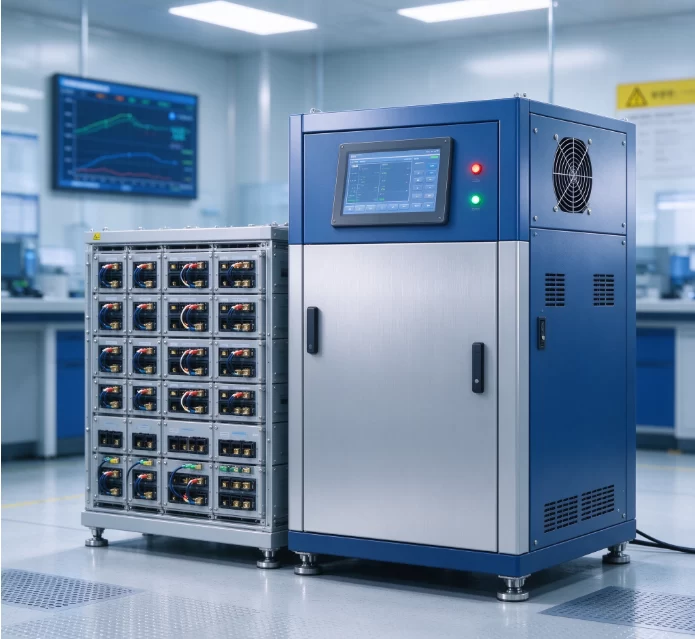
The Catalysts Driving Battery Testing Evolution by 2026
The shift in testing methodology is not happening in a vacuum. It is being accelerated by clear technological, commercial, and regulatory forces that render older test benches obsolete.
- Extreme Fast Charging (XFC): Delivering an 80% charge in under 10 minutes requires current rates of 4C to 6C. High currents generate intense localized heat, accelerate lithium plating, and stress internal cell interconnects. Test benches must now supply higher currents while capturing high-speed transient voltage responses.
- Next-Generation Chemistries: Solid-state batteries (SSBs) eliminate volatile liquid electrolytes but introduce new physical challenges. They require precise, constant mechanical pressure during cycling to prevent interface degradation. Sodium-ion cells present different electrochemical impedance characteristics that demand dedicated cycling profiles.
- Regulatory Pressures: Global standards are raising the barrier to market entry. Testing must satisfy updated UN 38.3 transportation requirements, UL 9540A large-scale fire propagation criteria, and the EU Battery Passport mandate for carbon footprint and lifecycle traceability.
Five Key Trends Defining Battery Testing Equipment in 2026
To navigate these commercial and technical hurdles, manufacturers are adopting new test architectures. Below are the five dominant trends defining the next generation of test hardware and software platforms.
1. AI-Driven Predictive Cycling and Digital Twins
Traditional lifecycle validation requires cycling a cell for thousands of hours to measure capacity fade. This prolonged timeline delays vehicle launches and increases R&D overhead. By 2026, machine learning models integrated directly into the test software will eliminate much of this delay.
Modern battery testing equipment now analyzes early-life cycling data—specifically subtle shifts in differential capacity (dQ/dV) curves during the first 100 cycles. Predictive algorithms extrapolate this data to forecast remaining useful life, State of Health (SOH), and early internal short circuits with high accuracy. This capability cuts validation timelines by up to 50%.
Furthermore, hardware-in-the-loop (HIL) systems run digital twins of the target battery pack alongside physical hardware. Engineers simulate dynamic drive cycles, sudden load drops, and regeneration events without destroying prototype hardware prematurely.
2. High-Precision Multi-Channel Systems for Next-Gen Chemistries
As cell chemistries become more complex, standard measurement tolerances are no longer acceptable. High-precision cell testing requires measurement accuracy down to the micro-volt and micro-amp level, combined with rapid sampling frequencies.
Accurate Coulombic Efficiency (CE) measurement serves as a direct indicator of parasitic side reactions within the cell. Detecting these micro-reactions requires measurement precision better than 0.01% of full scale. Newer cycling platforms feature independent channel control, allowing engineers to test diverse cell formats concurrently without channel cross-talk or thermal drift.
For solid-state cells, HAOEN integrates specialized fixtures that apply uniform, monitored mechanical pressure during electrical cycling. This setup ensures that solid-state interfaces remain intact throughout volumetric expansion and contraction.
3. Upgraded Thermal Runaway and Abuse Safety Chambers
Thermal runaway remains the primary safety concern for high-energy-density cells. Low-cobalt, high-nickel chemistries (like NMC 811 and NMC 955) offer exceptional energy density but lower thermal stability thresholds. As a result, thermal runaway testing equipment must withstand increasingly violent failure modes.
Safety containment chambers now feature advanced blast mitigation, automated fire suppression, and integrated gas analysis. Modern nail penetration, crush, and overcharge test rigs do not merely record whether a fire occurs; they capture real-time venting dynamics, gas composition (such as CO, H2, and HF emissions), and thermal propagation vectors using high-speed infrared sensors.
These upgraded chambers allow automotive manufacturers to establish precise safety margins and design effective cell-to-pack thermal barriers, satisfying stringent UL 9540A and GB 38031 requirements.
4. Fully Automated End-to-End Test Lines
Manual loading, manual wiring, and isolated test benches create bottlenecks in multi-gigawatt battery plants. By 2026, the industry standard for end-of-line (EOL) testing is moving toward fully automated battery test lines.
These automated environments combine automated guided vehicles (AGVs) and robotic arms to manage cell tray loading, open-circuit voltage (OCV) sorting, AC internal resistance (ACIR) checks, and direct current internal resistance (DCIR) pulse tests. Removing human handling delivers three immediate benefits:
- Consistent contact resistance across all test points, eliminating false rejects.
- Drastic reductions in cycle time, keeping pace with high-speed electrode winding lines.
- Protection for plant personnel by isolating cells undergoing high-rate charge/discharge conditioning.
5. Digital Compliance and Carbon Footprint Traceability
The regulatory environment is shifting from static certification toward active, cradle-to-grave digital documentation. The EU Battery Passport takes full effect by 2026, requiring battery makers to document everything from raw material provenance to carbon intensity and degradation curves.
Contemporary battery testing equipment interfaces directly with enterprise Manufacturing Execution Systems (MES) and secure cloud repositories. Test data is timestamped, cryptographically linked to the specific cell serial number, and preserved for audit readiness.
Software ecosystems now automatically compile complete compliance packages for UN 38.3 transport safety, IEC 62660, and ISO 26262 functional safety, saving teams months of manual documentation preparation.
Strategic Framework: Selecting Battery Testing Equipment
Procuring capital equipment for 2026 requires engineering and procurement teams to look beyond initial purchase costs. Facilities must weigh key technical trade-offs to ensure long-term ROI and operational flexibility.
Channel Density and Facility Footprint: Real estate in battery gigafactories and testing laboratories carries a premium. High-density battery cycler system architectures pack more channels into smaller footprints, reducing facility HVAC demands and floor space requirements.
Regenerative Energy Efficiency: High-rate battery formation, aging, and validation consume megawatts of electricity. Modern battery testing equipment must incorporate regenerative power conversion stages with efficiencies exceeding 90%. By feeding discharged energy back into the facility grid or adjacent test channels, companies lower operating expenses and decrease operational carbon footprints.
Cross-Platform Compatibility: Many laboratories validate everything from small pouch cells to multi-kilowatt packs. Selecting modular testing hardware that supports cell-level characterization, module balancing, and pack-level drive simulation protects capital budgets against future shifts in product format.
Open Software APIs: Closed, proprietary software environments slow down custom R&D. Leading equipment provides open APIs compatible with Python, MATLAB, LabVIEW, and standard industrial CAN/LIN communication buses. This allows engineers to deploy customized stress profiles and export data smoothly into analytics pipelines.
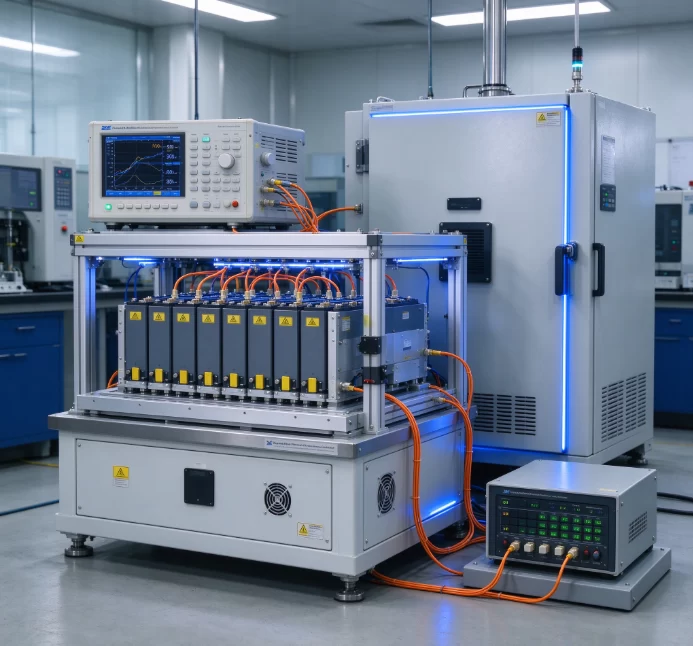
Position Your Operations for the Next Standard of Battery Performance
The expectations placed on energy storage technologies will only intensify as 2026 approaches. Battery failures carry heavy costs—ranging from expensive product recalls to catastrophic field failures that damage brand reputation. Precision testing infrastructure is no longer just a quality control line item; it is a primary risk mitigation strategy.
Deploying adaptable, accurate, and high-throughput battery testing equipment allows engineering organizations to develop safer chemistries, validate packs against international benchmarks, and release commercial products ahead of competitors.
HAOEN delivers production-ready and lab-scale testing systems designed to handle the challenges of next-generation chemistries, high-voltage architectures, and complex global compliance frameworks. Contact our technical sales specialists today to schedule an engineering review, discuss your application parameters, or request an equipment proposal.
Frequently Asked Questions
Q1: Why is regenerative power capability essential for modern battery testing equipment?
A1: High-power battery cycling, particularly for EV battery packs, consumes massive amounts of electrical power. Regenerative test equipment converts the energy discharged from the battery back into usable AC electricity and feeds it back into the laboratory or factory grid with over 90% efficiency. This substantially lowers electricity utility costs, decreases system heat generation, and reduces the facility's cooling requirements.
Q2: How do solid-state batteries alter physical test bench requirements?
A2: Unlike conventional lithium-ion cells with liquid electrolytes, solid-state batteries depend on continuous physical contact between solid electrodes and the solid electrolyte separator. During cycling, these layers expand and contract. Modern testing equipment must incorporate specialized test fixtures equipped with load cells and pneumatic or mechanical actuators to apply and measure controlled pressure throughout the charge-discharge cycle.
Q3: What role does battery testing equipment play in EU Battery Passport compliance?
A3: The EU Battery Passport requires clear verification of a battery’s origin, composition, state of health, and lifecycle carbon footprint. Modern testing platforms directly transmit real-time performance, degradation data, and energy consumption metrics to MES and ERP databases via secure APIs. This automated data pipeline creates the transparent, unalterable digital paper trail necessary for European regulatory compliance.
Q4: Can a single test platform handle cell, module, and pack-level testing?
A4: Typically, cell testing requires low-voltage, high-precision channels (e.g., 0-5V, micro-amp to moderate amp ranges), while pack testing demands high-voltage, high-power systems (e.g., up to 1000V and several hundred amps). However, modular test architectures allow laboratories to parallel multiple lower-power channels to test higher-capacity modules or integrate unified control software that governs distinct cell, module, and pack hardware using a single user interface.
Q5: How does automated battery testing improve yield compared to manual testing?
A5: Automated battery test lines eliminate operator-induced variations, such as inconsistent probe contact pressure, manual wiring errors, and data entry mistakes. Automated systems guarantee repeatable fixture placement, ensure continuous temperature tracking, and instantly segregate out-of-spec cells using integrated sorting algorithms. This increases manufacturing yields, reduces cycle times, and enhances product safety.