

Dust is everywhere, and it is aggressive. Fine particles settle inside outdoor power supplies, penetrate automotive sensor housings, and coat industrial control boards. The result is always the same: thermal failure, short circuits, or outright system shutdown.
For original equipment manufacturers (OEMs), unverified enclosures present a massive commercial liability. Field failures lead to sudden warranty claims, costly recalls, and lost contract bids in regulated markets like North America and the European Union.
Standardized dust testing validates that your product enclosure keeps out fine particulates under harsh working conditions. Whether you design off-grid solar inverters, heavy equipment telemetry, or ruggedized handhelds, physical testing proves your product will survive.
At HAOEN, we engineer environmental test equipment to help manufacturing teams detect enclosure weaknesses long before mass production begins. If you are preparing a new product for commercial compliance, contact our technical team today for testing system recommendations or chamber specifications.
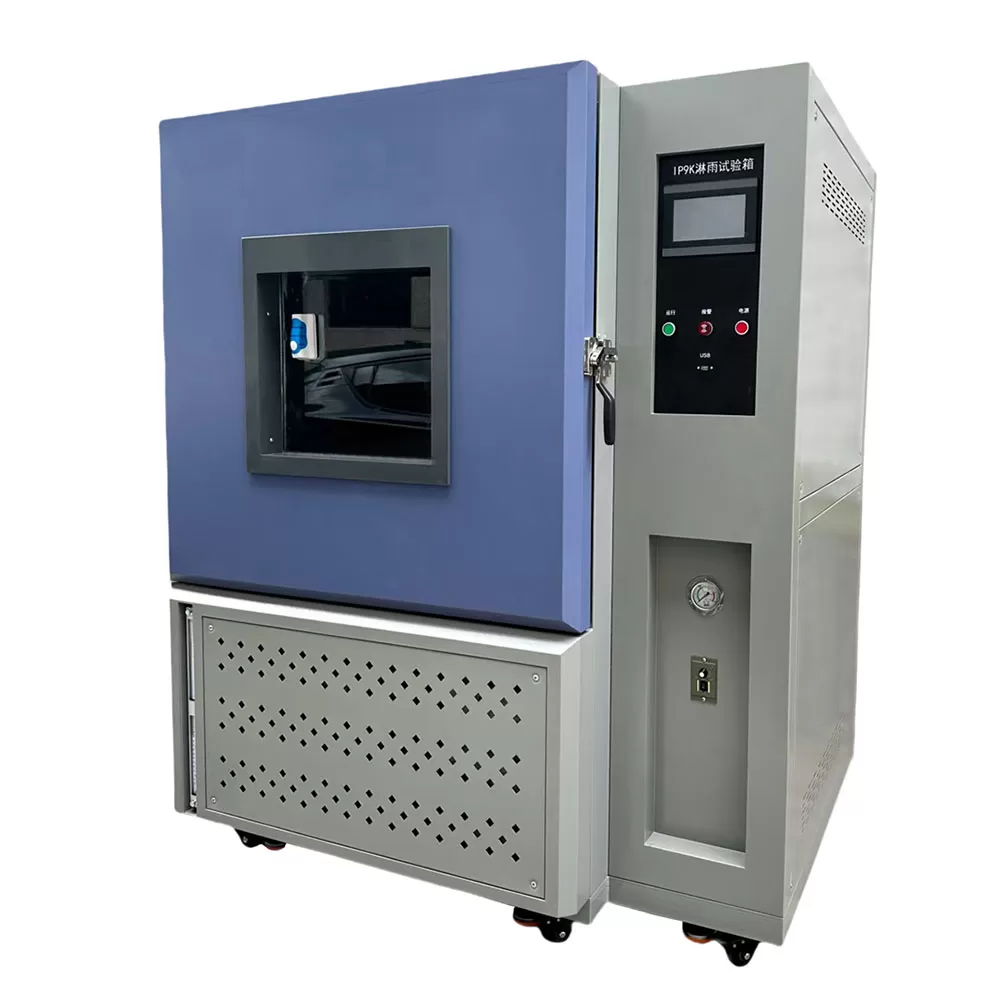
1. Why Dust Testing Matters for Hardware Manufacturing
Airborne particulates do not just make products look dirty. They trigger active physical and electrical failure modes inside sealed enclosures.
The Real Failure Modes of Particulate Ingress
Dielectric breakdown: Atmospheric dust often carries conductive mineral traces or absorbed moisture. When it settles across printed circuit board (PCB) traces, it creates parasitic leakage paths and terminal short circuits.
Thermal choking: Layered dust acts as an insulating blanket. It suffocates power MOSFETs, inductors, and microprocessors, spiking junction temperatures and accelerating component degradation.
Abrasive mechanical wear: In rotating assemblies, actuators, and cooling fans, fine silica dust grinds away bearing races and binds sliding linkages.
Optical interference: Dust accumulation degrades LiDAR windows, security camera domes, and optical sensors, distorting signal pathways and triggering system errors.
Commercial Risk and Market Access
Deploying equipment into mining, agricultural, rail, or utility sectors requires documented ingress ratings. Tenders demand certified proof that enclosures meet internationally recognized benchmarks such as IEC 60529.
Relying on computer simulations for enclosure validation is a massive gamble. Gasket deflection, thermal cycling, and manufacturing tolerances create microscopic gaps that only controlled dust testing can expose.
2. Decoding IP Dust Ratings: IP1X to IP6X
The Ingress Protection (IP) rating system uses two numbers. The first digit defines solid particle and dust protection, scaled from 0 (unprotected) to 6 (dust-tight).
| Rating | Solid Size Protected Against | Test Definition & Methodology |
|---|---|---|
| IP1X | Objects > 50 mm | Protection against accidental contact with large body parts like the back of a hand. Tested with a 50 mm sphere probe. |
| IP2X | Objects > 12.5 mm | Protection against fingers or small tools. Tested with a jointed test finger and 12.5 mm sphere. |
| IP3X | Objects > 2.5 mm | Protection against tools, thick wires, and foreign objects using a 2.5 mm rod probe. |
| IP4X | Objects > 1.0 mm | Protection against fine wires, nails, and slender tools using a 1.0 mm rigid steel wire. |
| IP5X | Dust-Protected | Ingress of dust is not entirely prevented, but dust cannot enter in amounts that interfere with safe operation or insulation. |
| IP6X | Dust-Tight | No ingress of dust whatsoever. The enclosure is completely sealed under continuous vacuum pressure. |
IP5X vs. IP6X: Defining the Threshold
The critical divergence for industrial hardware engineers happens between IP5X and IP6X. Choosing the wrong level drives up manufacturing costs or causes premature field failure.
IP5X (Dust-Protected) accepts minor dust ingress. The laboratory evaluates the unit after exposure to verify that any dust that entered did not land on dielectric surfaces, sensitive contacts, or optical pathways. It works well for indoor industrial controls, factory automation racks, and commercial power tools.
IP6X (Dust-Tight) accepts zero dust. If a single grain of test dust enters the housing during the vacuum test cycle, the unit fails immediately. This level is essential for automotive control units (ECUs), marine navigation displays, and outdoor telecom nodes.
Avoid over-engineering. An indoor panel does not need an IP6X vacuum seal. Designing for IP6X requires expensive continuous gaskets, tighter fastener spacing, and thicker plastic walls to resist negative pressure deformation.
3. Key Regulatory Standards: IEC 60529, ISO 20653, and MIL-STD-810H
Different industries measure ingress resistance under distinct environmental conditions. You must test against the exact standard tied to your target market.
IEC/EN 60529
This is the international benchmark for general electrical enclosures. It defines the classic IP codes (IP1X through IP6X). The standard details the physical test rig, particle mesh sizes, airflow conditions, and post-test electrical insulation checks.
ISO 20653
Developed specifically for road vehicles, this standard introduces the "K" designation (such as IP5KX and IP6KX). Automotive applications face intense air currents, extreme temperature fluctuations, and fine road silt.
ISO 20653 dust testing uses different dust formulations and higher air velocities than standard commercial tests. The "K" signifies special test conditions tailored to under-hood and chassis environments.
MIL-STD-810H (Method 510.7)
Military hardware operates under harsher conditions than standard IP codes evaluate. MIL-STD-810H Method 510.7 breaks the evaluation into two distinct operations:
Blowing Dust: Small particles (< 150 µm) blown across the unit at air velocities up to 8.9 m/s, simulating desert windstorms.
Blowing Sand: Larger silica particles (150 to 850 µm) blasted at high speeds (up to 29 m/s) to evaluate abrasive structural erosion.
4. Inside the Dust Test Chamber: How the Evaluation Works
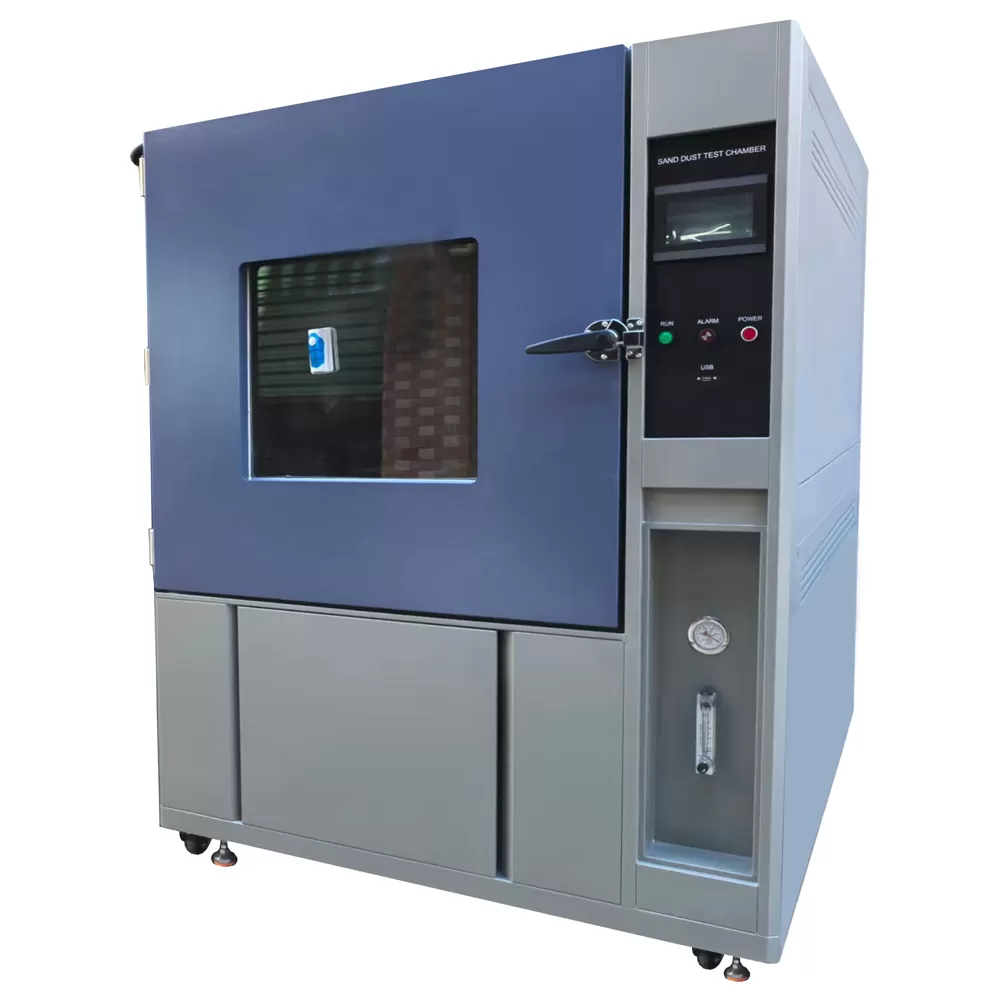
Real-world testing requires controlled, repeatable laboratory conditions. A specialized dust test chamber recirculates standardized media to create a dense, suspended dust cloud around the device under test (DUT).
The Test Media: Talcum vs. Arizona Dust
Standard room dust will not work for official certification. Test laboratories rely on tightly controlled synthetic compounds:
Talcum Powder: Used primarily for IEC 60529 evaluations. The powder must pass through a fine wire mesh with a nominal wire diameter of 50 µm and a clear gap size of 75 µm. It flows into microscopic gaps with ease.
Arizona Road Dust (ISO 12103-1, A2 Fine / A4 Coarse): Composed mainly of silica and aluminum oxide. It features sharp, jagged edges that accelerate mechanical binding, abrasive seal wear, and optical scratching.
Category 1 vs. Category 2 Enclosures
IEC 60529 splits products into two categories, dictating whether you must hook the unit to a vacuum pump:
Category 1: The internal working pressure of the enclosure is lower than the surrounding atmosphere. This occurs when internal electronics warm up during operation and cool down after shutdown, creating a thermal vacuum. Category 1 requires pulling continuous vacuum pressure through an extraction port drilled into the unit.
Category 2: The pressure inside the housing remains equal to atmospheric pressure. The unit undergoes passive circulation testing without an extraction hose attached.
The Step-by-Step Test Procedure
Professional test facilities and equipment manufacturers, including HAOEN, follow a strict progression during laboratory evaluations:
Pre-conditioning: Technicians inspect the unit, measure initial insulation resistance, and weigh the housing.
Chamber Preparation: The correct media (such as dry talcum powder at 2 kg per cubic meter of chamber volume) is loaded into the hopper.
Pressure Connection: For Category 1 units, technicians install a pressure tap and vacuum hose. The test system pulls a negative pressure of up to 2 kPa (20 mbar) through the enclosure.
Circulation Cycle: The chamber blowers suspend the dust uniformly. The test runs continuously, typically between 2 and 8 hours depending on extraction volume limits (maximum 80 times the volume of the housing).
Settling Period: The blowers stop, letting the cloud settle naturally before opening the chamber doors.
Inspection & Breakdown: Engineers wipe down exterior surfaces, open the housing, and document any ingress. Finally, the unit undergoes high-voltage dielectric withstand checks to verify electrical safety.
5. Design for Ingress Protection: Common Engineering Pitfalls and Fixes
Prototypes frequently fail their initial dust testing runs. Most failures stem from simple mechanical oversights rather than flawed product architectures.
Gasket Compression and Material Selection
Gaskets must seal uniformly around the entire perimeter. If your design under-compresses a gasket, dust slips past. If it over-compresses the material, the gasket cracks or takes a permanent set.
Compression ratio: Maintain a 25% to 35% compression deflection for solid elastomer O-rings under nominal bolt torque.
Material choices: Use Silicone for broad thermal stability (-50°C to 200°C) or EPDM for resistance to moisture, ozone, and outdoor weathering. Avoid standard open-cell polyurethane foams; they act like air filters that trap and channel fine particulates straight inside.
Enclosure Rigidity and Screw Pitch
When running a Category 1 IP6X test, the 2 kPa vacuum exerts continuous inward mechanical force on the housing walls. Long, unsupported plastic walls bow inward under this pressure differential.
This deflection pulls the mating lip away from the gasket, creating micro-channels at the midpoint between screws. Stiffen the perimeter walls with internal ribs and tighten your screw spacing to maintain uniform clamping force along every millimeter of the joint.
Breather Vents for Pressure Equalization
If you cannot stop thermal vacuum from pulling dust past your seals, vent the pressure intentionally. Integrating an expanded polytetrafluoroethylene (ePTFE) vent plug allows air molecules to pass freely while blocking dust grains down to fractions of a micron.
This vent equalizes pressure differentials continuously. It neutralizes the vacuum effect that pulls dust through gasket micro-tears and reduces physical stress on enclosure joints.
6. Sourcing Strategy: In-House Chambers vs. Third-Party Labs
Developing an ingress-resistant product requires multiple design iterations. Relying entirely on accredited third-party test houses can slow down your design cycle.
When to Build In-House Testing Capabilities
Third-party lab bookings often cost thousands of dollars per attempt and require weeks of advance scheduling. If an enclosure fails 20 minutes into an eight-hour test, the lab must still charge you for the full slot. You have to patch the design, ship new samples, and wait in line again.
Investing in your own dust test chamber gives your R&D and QA teams on-demand verification. You can test rough prototypes, evaluate gasket options, and confirm mold modifications within hours. When selecting a commercial chamber, verify several key specifications:
Precise airflow velocity and hopper vibration controls to keep media from clumping.
Integrated vacuum flowmeters, differential pressure gauges, and air extraction pumps for Category 1 evaluations.
Reliable heating systems to keep talcum powder completely dry in humid factory settings.
When to Use Third-Party Test Houses
Independent, ISO/IEC 17025 accredited test laboratories remain indispensable for final compliance. Customers, insurers, and regulatory bodies demand stamped certification reports from accredited bodies before issuing operating permits or paying out large contract milestones.
The smartest product development workflow merges both paths: iterate rapidly using internal environmental chambers, then submit a vetted, fully validated design to external labs for official certification.
Frequently Asked Questions (FAQ)
Q1: What is the main difference between IP5X and IP6X
testing?
A1: IP5X allows a limited amount of
non-conductive, non-damaging dust to enter the enclosure. In contrast, IP6X
requires an absolute seal; finding even trace amounts of dust inside the
enclosure after the test results in immediate failure.
Q2: Why does an IP6X test require pulling a vacuum on the
enclosure?
A2: Enclosed electronics heat the air
inside their housing during operation. When powered down, the internal air cools
rapidly, contracting and creating an internal vacuum. The vacuum test simulates
this suction to prove that ambient air currents will not drag dust into the
enclosure through gasket seals.
Q3: Can a product pass an IPX7 water test but fail an IP6X dust
test?
A3: Yes. Water has surface tension, which
helps prevent it from entering microscopic crevices. Dry talcum powder particles
(measuring under 75 microns) have no surface tension and flow like a liquid,
easily passing through tiny dry fissures that block water droplets.
Q4: How long does a standard IEC 60529 dust test
take?
A4: An IEC 60529 test run typically lasts
between 2 and 8 hours. The exact duration depends on the extraction volume and
air extraction rate of the enclosure under test, capped at a maximum of 80 times
the internal volume of the unit.
Q5: What dust media is used for automotive electronics testing under
ISO 20653?
A5: ISO 20653 often relies on Arizona
Road Dust (ISO 12103-1) formulations rather than pure talcum powder. Arizona
dust contains hard, irregular particles of silica, aluminum oxide, and iron
oxide, closely simulating real-world road silt, engine bay grime, and gravel
dust.
Upgrade Your Enclosure Reliability with HAOEN
Reliable hardware begins with rigorous environmental screening. Enclosure leaks that escape the factory lead directly to field failures, expensive warranty claims, and damaged reputations.
HAOEN designs and manufactures robust environmental testing equipment, including advanced chambers built for IEC 60529, ISO 20653, and customized dust-testing protocols. Our systems deliver precise airflow control, integrated vacuum extraction arrays, and intuitive digital interfaces to support every stage of product validation.
Ready to bring physical testing in-house? Talk with our technical sales engineers to discuss your product requirements, request an equipment catalog, or get a formal quote on our dust-testing chamber line.