

Selecting the wrong environmental simulation system wastes capital and stalls product development. If your test station fails an audit or yields inconsistent water ingress data, your team faces delayed certifications and expensive re-testing.
Quality and compliance managers must balance chamber footprint, flow control precision, and international standards. A structured evaluation strategy prevents costly procurement mistakes.
Manufacturers like HAOEN design testing systems to solve these exact operational bottlenecks. This 7-point checklist gives lab managers practical criteria to choose the ideal rain test equipment for long-term testing success.
Need an immediate consultation or custom equipment proposal? Contact our engineering team today for an expert technical assessment.
1. Identify Your Target Standards & IP Ratings
Your product roadmap dictates the water protection testing your lab must conduct. A consumer wearable has vastly different enclosure demands than an automotive powertrain sensor or an outdoor telecom cabinet.
Matching IPX1 to IPX9K Requirements
Ingress protection testing spans a wide spectrum of liquid severity levels. You must determine whether your laboratory needs dedicated single-stage gear or a combined multi-rating system:
- Drip Box Systems (IPX1 & IPX2): Used for checking vertical water drops or 15° tilted drips. These require micro-machined drip apertures and controlled flow rates.
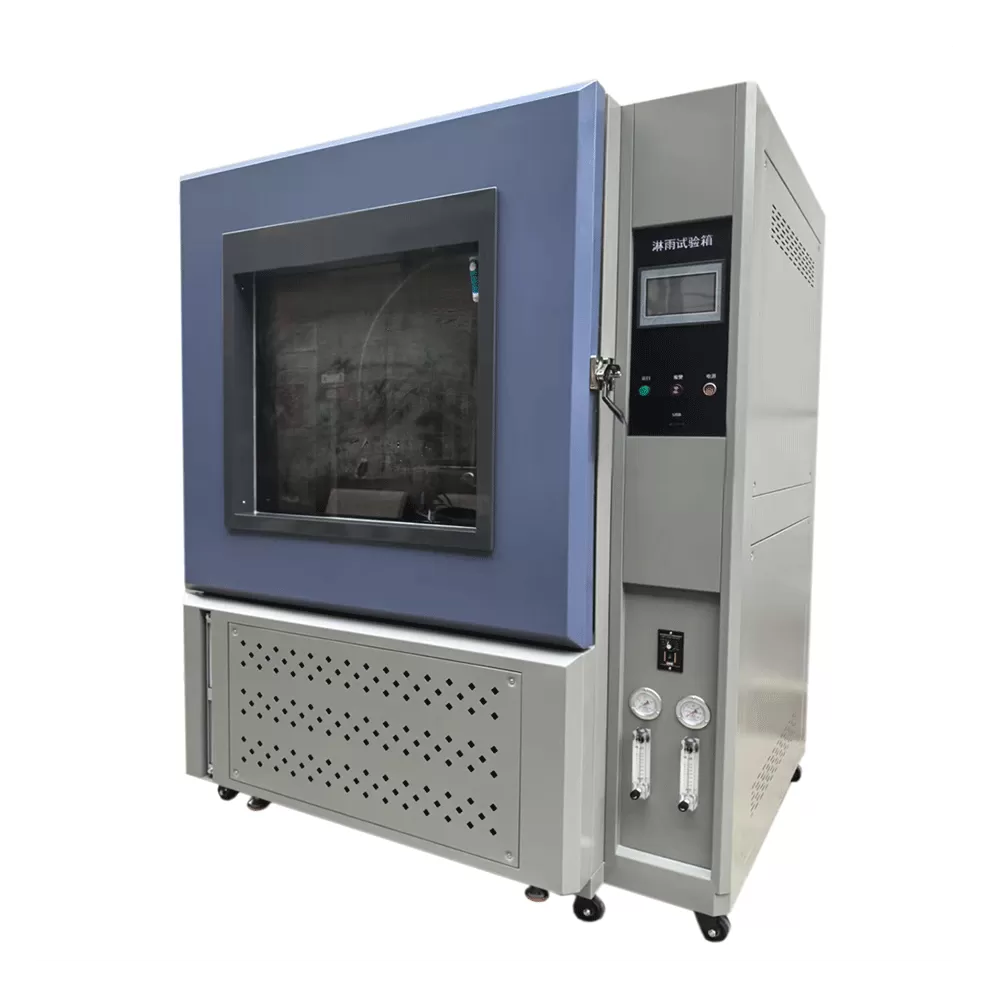
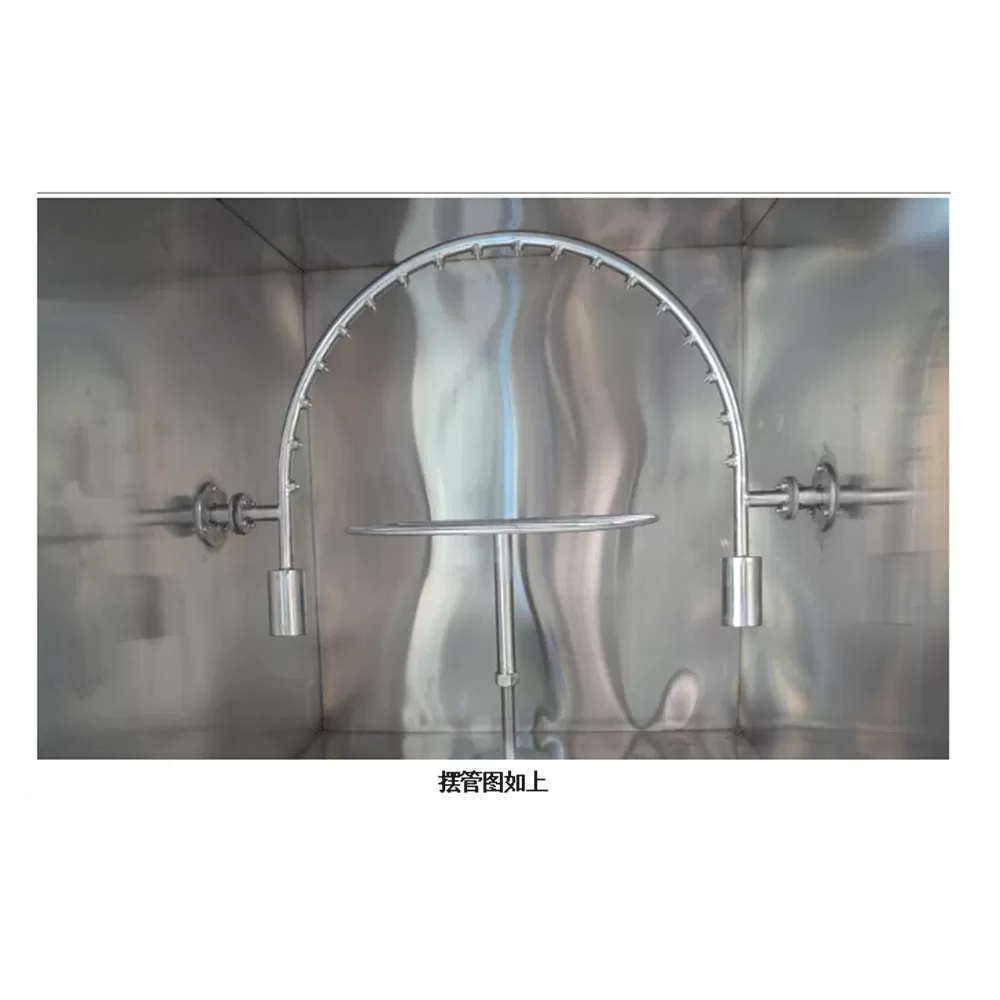
- Oscillating Tube Systems (IPX3 & IPX4): Designed for spraying and splashing water tests. The swing pipe radius and nozzle layout must cover the unit under test cleanly.
- Water Jet Test Apparatus (IPX5 & IPX6): Employs standard 6.3 mm and 12.5 mm nozzles to project high-volume water jets against enclosures.
- High-Pressure Thermal Spray (IPX9K): Demands water heated to 80°C and pressurized up to 100 bar to test resistance to steam cleaning.
Compliance with Global Standards
Ensure the hardware conforms to your industry-specific testing rules. The foundational benchmark is IEC 60529 test equipment architecture. Automotive suppliers must also confirm compliance with ISO 20653 and DIN 40050-9. Defense labs will require procedures found in MIL-STD-810 Method 506.
2. Specimen Dimensions vs. Chamber Capacity
Chamber sizing involves more than comparing the width and height of your test specimen with internal cabinet walls. You must evaluate usable volumetric capacity and dynamic clearance during active test cycles.
Effective Testing Volume
Water spray patterns require specific clearance distances to form correct spray profiles according to standard methods. Most standards demand 200 mm to 400 mm of space between the nozzle tip and the product boundary.
You also need to inspect turntable mechanics. Confirm the rotation mechanism can handle the static and off-center weight of your heaviest products without bearing strain or rotational speed drift.
Walk-in vs. Benchtop Rain Test Equipment
The form factor of your equipment depends on your sample dimensions and laboratory real estate:
- Benchtop/Reach-In Enclosures: Ideal for small consumer electronics, lighting modules, and medical devices. They offer compact footprints and quick plumbing hookups.
- Walk-In Chambers: Mandatory for large automotive components, solar panels, and complete electric vehicle battery packs. These walk-in rooms demand reinforced floors and higher drainage thresholds.
3. Precision Control of Water Pressure and Flow Rate
Repeatability is the core requirement of any accredited test lab. Minor variations in nozzle pressure or liquid delivery will compromise test integrity and lead to disputed results during compliance audits.
Sensor Accuracy and Calibration
Look for digital flow meters and electronic pressure transducers that meet ISO 17025 calibration thresholds. Mechanical float meters and analog needle gauges can drift over time due to wear, vibration, and water hardness scale.
Your rain test apparatus must maintain flow stability within the ±5% limits mandated by IEC protocols. Premium systems employ frequency-inverter pump drives to maintain smooth water delivery across variable cycle lengths.
Dynamic Speed Control
Mechanical components must move without stutter or gear backlash. The turntable should allow adjustable rotational speeds, typically between 1 rpm and 5 rpm.
Oscillating tubes require servo or precision stepper motor drives. They need programmable angle adjustments up to ±180° so technicians can execute IPX3 and IPX4 procedures without physical adjustments.
4. Water Filtration and Recycling Efficiency
Continuous water spray testing consumes thousands of liters of liquid during back-to-back quality audits. Running an open-loop system quickly strains utility budgets and lab floor drains.
Closed-loop vs. Open-loop Systems
An open-loop setup routes incoming municipal water through the spray nozzles straight to the building drain. This works for occasional tests, but high-throughput labs will find it expensive.
A closed-loop, recirculating water system reclaims run-off inside an integrated reservoir tank. Manufacturers like HAOEN build multi-stage recycling units directly into their IPX rain test chamber assemblies, cutting daily water usage by up to 85%.
Filtration Durability and Nozzle Protection
Precision spray nozzles feature tiny apertures, particularly on IPX1 drip boxes and IPX3/IPX4 oscillating pipes. Fine sediment or mineral scale will clog these tips instantly.
- Choose systems equipped with dual-stage or three-stage filtration assemblies.
- Ensure the first filter catches coarse debris shed by test articles.
- Use a secondary fine mesh or cartridge filter to scrub particles down to 50 microns or smaller before fluid reaches the pump head.
5. Chamber Build Quality & Corrosion Resistance
A water spray test apparatus operates under continuous humidity, thermal swings, and constant contact with wet surfaces. Build quality dictates whether your investment lasts for a decade or rusts within two years.
Material Selection: SUS304 vs. SUS316 Stainless Steel
The internal test space must be built from high-grade stainless steel. Standard commercial chambers use SUS304 steel, which provides dependable corrosion resistance for general city-water testing.
If your test methods introduce salt spray carryover, detergents, or chemical tracing agents, select SUS316 stainless steel interiors. SUS316 contains molybdenum, protecting welds and corners against pitting corrosion.
Observation Windows and Anti-Fog Features
Engineers must monitor the sample during testing to spot initial points of seal failure. Ensure the main door incorporates multi-layer tempered safety glass.
Look for built-in, manual windshield wipers and interior LED lighting arrays. Heated glass options prevent condensation and fogging on the internal view screen during extended test routines.
6. Automation, UI, and Data Logging Capabilities
Manual valve adjustments and analog switches reduce lab efficiency. Modern test labs demand digital controllers that simplify run setups and capture full process records.
Programmable Logic Controllers (PLC)
A color touch-screen interface tied to an industrial PLC improves operator productivity. The controller should feature pre-loaded software profiles for all core IEC, ISO, and standard test cycles.
It should also allow technicians to program custom water spray cycles. This lets engineers combine varied rotation speeds, intermittent sprays, and variable durations for aggressive R&D stress testing.
Traceability and Data Export
Quality auditing bodies require clear proof that parameters stayed within tolerance throughout the test run. Your rain test equipment should log data automatically:
- Real-time tracking of flow rates, system pressure, and total water volume.
- Turntable rpm, tube swing angles, and run durations.
- Instant export of run history and alarm logs via USB flash drive or local Ethernet connections.
7. Vendor Reliability, Certification & After-Sales Support
The operational lifespan of environmental test chambers depends on the reliability of the manufacturer and their field service support. Even sturdy equipment requires servicing, nozzle replacements, and annual recalibration.
Third-Party Calibration and Certification
Confirm the vendor builds equipment under ISO 9001 quality standards and provides a factory CE Declaration of Conformity. Request proof that the flow and pressure instruments can be calibrated against ISO/IEC 17025 accredited transfer standards.
Ask the supplier whether they can provide on-site validation documents (Installation Qualification/Operational Qualification) to support your internal audits.
Warranty Terms and Spare Parts Availability
Examine the parts availability for critical wear items. Nozzles, water pump seals, wiper blades, and solenoid valves need regular maintenance. A supplier with ready stock prevents minor hardware failures from idling your testing lab.
Comparison: Key Features Across Standard IPX Testing Levels
Use the following summary table to align your product testing targets with required equipment specifications:
| IP Level | Primary Method | Flow Rate / Pressure | Critical Hardware Factor |
|---|---|---|---|
| IPX1 / IPX2 | Drip Box Array | 1 mm/min to 3 mm/min drip rate | Cleanable micro-nozzles; level adjustment |
| IPX3 / IPX4 | Oscillating Tube or Hand Nozzle | 0.07 L/min per hole; 50–150 kPa | Angle control (±60° to ±180°); smooth servo drive |
| IPX5 / IPX6 | Targeted Water Jet | 12.5 L/min (IPX5); 100 L/min (IPX6) | High-flow booster pump; rugged drain floor |
| IPX9K | High-Pressure Thermal Spray | 14–16 L/min; 8000–10000 kPa; 80°C | Heated water reservoir; heavy-duty steel safety frame |
Conclusion & Next Steps
Purchasing professional rain test equipment protects your brand reputation and product reliability. By evaluating IP ratings, capacity limits, flow accuracy, and build materials up front, you avoid unexpected downtime and failed compliance audits.
HAOEN manufactures environmental test chambers and ingress testing systems engineered to meet international test requirements. Whether you require a standard benchtop splash cabinet or a fully customized walk-in water spray test facility, our engineers can assist.
Need an accurate quote or technical advice? Connect with our sales engineering team today to review your test specifications and receive an actionable equipment proposal.
Frequently Asked Questions (FAQ)
Q1: What is the main difference between IPX4 and IPX4K tests?
A1: IPX4 evaluates splashing water resistance using an oscillating tube or handheld spray nozzle at standard pressure levels up to 150 kPa under IEC 60529. IPX4K is specified in automotive standards like ISO 20653. It requires an increased water pressure of 400 kPa, demanding a higher-output pump and reinforced spray fittings.
Q2: Can one single rain test chamber execute IPX1 through IPX6 tests?
A2: Yes. Multi-functional ingress protection testing chambers combine drip platforms, oscillating tubes, and jet nozzle connections in one housing. These multi-purpose stations save valuable lab space, though technicians must change out connections when switching test methods.
Q3: How often should we calibrate the nozzles and flow sensors?
A3: Labs should calibrate flow sensors and pressure gauges every 12 months under standard operating conditions. Spray nozzles require visual inspection and flow verification every six months to detect mineral buildup or physical wear that could distort spray patterns.
Q4: Why is water purity important in rain test equipment?
A4: Minerals and suspended particles in untreated water clog fine nozzle apertures and cause pump seal wear. Dissolved solids can also leave residue on the test specimen, interfering with optical checks or electrical components. Using demineralized or filtered water extends equipment service intervals.
Q5: What are the electrical power requirements for high-pressure IPX9K equipment?
A5: IPX9K test apparatus requires significantly more power than standard low-pressure equipment. Because it uses high-pressure piston pumps and electric heating elements to reach 80°C, it typically requires a 3-phase electrical connection (380V/440V, 50/60Hz) pulling between 15 kW and 30 kW.