

Harsh operating environments destroy electronics and mechanical components. Fine particles find every weak seal, degrade electrical contacts, and accelerate mechanical wear. Because of this, modern quality frameworks demand rigorous dust ingress test validation.
Automotive electronics, electric vehicle (EV) battery packs, solar inverters, and outdoor luminaires must satisfy stringent ingress protection standards. Meeting IP5X, IP6X, ISO 20653, and MIL-STD-810H requires specialized environmental testing equipment. The question is not whether you need a dust test chamber, but which configuration fits your facility.
Laboratories frequently face a difficult procurement crossroad: buy an off-the-shelf standard unit or commission an engineered-to-order custom system. At HAOEN, we manufacture both types of test systems. We see firsthand how this single decision shapes laboratory throughput, testing scope, and return on investment.
Planning a new environmental reliability lab or replacing an outdated system? Contact the HAOEN engineering team today to request full technical specifications, chamber schematics, and an immediate pricing estimate.
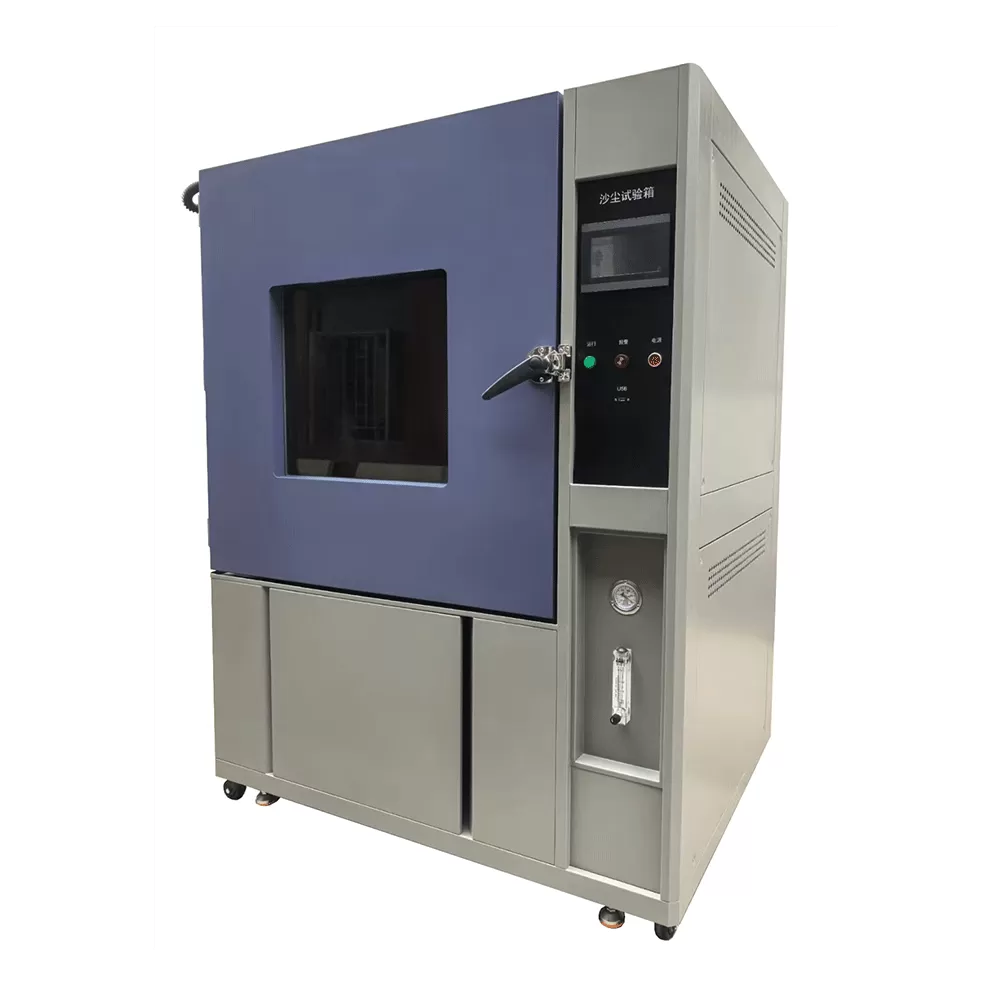
The Regulatory Driver: Dust Ingress Testing Under Modern Standards
Ingress protection testing is no longer a simple checkbox at the end of production. It is a critical gateway for regulatory approval and market entry. A standard dust test chamber forces dust particles against test specimens using targeted air velocity and pressure differentials.
IEC 60529 remains the primary global benchmark for commercial and industrial enclosures. Testing divides into two primary categories:
IP5X (Dust-Protected): Ingress of dust is not totally prevented, but dust cannot enter in quantities that interfere with safe equipment operation.
IP6X (Dust-Tight): No particle ingress is permitted throughout the entire test cycle under specified vacuum conditions.
Automotive applications require even tighter controls. ISO 20653 outlines testing protocols for road vehicles, specifying thermal shocks combined with dust deposition. Meanwhile, military equipment must survive coarse sand and severe desert turbulence governed by MIL-STD-810H Method 510. Choosing the right machinery starts with the standards you must satisfy.
Standard Dust Test Chambers: Efficiency, Compliance, and Speed
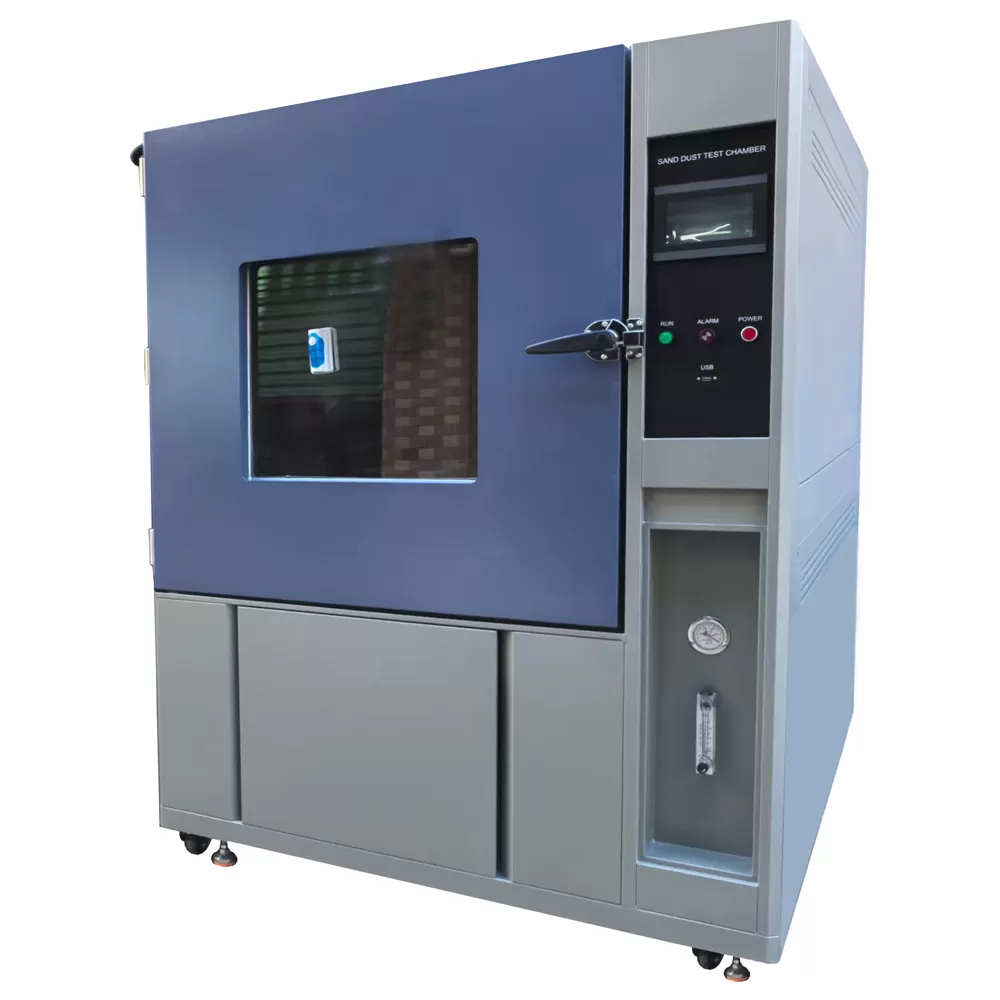
Standard units represent the backbone of commercial qualification laboratories. These systems are pre-engineered to meet common international standards right out of the crate.
Key Advantages of Standard Units
Fast Lead Times: Standard units rely on established bills of materials and pre-cut sheet metal. Production requires weeks rather than months, and manufacturers often keep standard sizes in stock. If you face an urgent customer audit or sudden product launch deadline, a standard dust test chamber is the fastest route to compliance.
Guaranteed Compliance for Common Standards: Pre-engineered machines are calibrated precisely for IEC 60529 and DIN 40050-9. They include the necessary underpressure pumps, flowmeters, vibration mechanisms, and talcum powder dosing systems to pass accreditation inspections without custom programming.
Predictable Capital Expenditure: Because research and development costs are distributed across hundreds of serial units, standard chambers cost significantly less upfront. Your finance team can approve standard capital expenditures (CapEx) quickly with low risk.
Operational Limitations
Standard machines have strict boundaries. Most models feature working volumes between 500 liters and 2,000 liters. Their structural shelves usually support between 50 kg and 100 kg.
Standard units also struggle with "live" testing. When an active electronic device runs inside a sealed box, it generates heat. Standard dust chambers lack dedicated cooling compressors to offset device heat, which can warp plastic seals or bake the circulating dust onto internal surfaces.
Best Suited For: Small sensors, consumer mobile devices, automotive lighting, cable glands, and commercial testing houses handling uniform, small-to-medium test specimens.
Custom Dust Test Chambers: Built for Complex Engineering Demands
When your test subject does not fit inside an off-the-shelf box, custom engineering becomes mandatory. Custom systems tackle unique geometries, extreme weights, and non-standard dust media.
Core Capabilities of Custom Dust Test Chambers
Extreme Dimensions and Heavy Payloads: Modern battery energy storage systems (BESS), complete EV battery trays, and industrial switchgear weigh hundreds or thousands of kilograms. A custom walk-in or drive-in sand and dust test chamber incorporates reinforced floor plates, drive-on ramps, and crane-loading roof hatches to handle large hardware safely.
Advanced Environmental Integration: Real-world desert environments involve more than still dust. Custom builds can integrate temperature conditioning, relative humidity control, and multi-axis mechanical vibration. This lets engineers simulate a heavy off-road vehicle driving through high-heat, high-dust terrain within a single test setup.
Abrasive Media Handling: Standard machines circulate fine talcum powder. However, military qualification often demands Arizona Road Dust (ISO 12103-1, A2 to A4) or coarse silica sand. These materials wear down standard blowers rapidly. Custom chambers use hardened ductwork, heavy-duty abrasion-resistant blowers, and specialized filtration recovery hoppers.
Power and Data Pass-Throughs: Complex testing demands active specimen monitoring. Custom systems provide specialized side ports, high-voltage busbar entries, and liquid-cooling line interfaces. These feed your specimen without breaking chamber pressure or leaking fine dust into the laboratory.
The Trade-Offs
Custom engineering demands patience and higher capital investment. Engineering reviews, CAD design, structural calculations, and bespoke PLC programming extend lead times to anywhere between 10 and 20 weeks. You must also account for site installation, facility air supplies, and high electrical feeds.
Industrial manufacturers like HAOEN bridge this gap by using modular engineering blocks. This approach shortens the lead time on custom builds without sacrificing structural flexibility.
Best Suited For: Electric vehicle powertrain components, defense electronics, aerospace systems, large photovoltaic inverters, and heavy mining hardware.
Procurement Decision Matrix: Standard vs. Custom
Engineering and procurement teams can use this comparative matrix to evaluate their testing requirements against project budgets and facility constraints.
| Evaluation Criteria | Standard Dust Test Chamber | Custom Dust Test Chamber |
|---|---|---|
| Internal Volume | 0.5 m³ to 2.0 m³ typical | Scalable from 3.0 m³ to walk-in rooms (50+ m³) |
| Specimen Weight Limit | 50 kg to 150 kg (distributed) | Up to several tons with reinforced flooring |
| Testing Media | Talcum powder, standard neutral dust | Coarse sand, silica, Arizona road dust, cement dust |
| Specimen Operation | Passive (unpowered) or low-heat active | Fully active with high-voltage inputs and cooling |
| Lead Time | 2 to 4 weeks (or from stock) | 10 to 18 weeks depending on complexity |
| Initial CapEx | Lower, highly standardized cost | Higher, includes non-recurring engineering (NRE) |
| Facility Impact | Minimal; standard power, plug-and-play | Requires structural planning, high-flow air, drainage |
3 Hidden Traps Procurement Teams Must Avoid
Buying test equipment is a long-term commitment. Laboratory directors often focus solely on internal chamber dimensions and purchase price, only to run into operational bottlenecks later. Watch out for these three pitfalls.
1. Overlooking Specimen Heat Dissipation
Testing powered electronics generates thermal loads. In a sealed IP6X vacuum test, heat builds up rapidly inside the cabinet. If internal temperatures exceed 40°C to 55°C, talcum powder can agglomerate and settle unevenly. This ruins the test repeatability. It can also cause the test specimen to shut down prematurely due to thermal protection rather than dust ingress.
If you plan to run active electronics inside your dust test chamber, calculate your specimen's maximum wattage. Make sure to specify an integrated cooling loop or heat exchanger early in the procurement phase.
2. Underestimating Dust Extraction and Lab Air Quality
What happens when the test finishes? You must open the chamber door to retrieve your specimen. Fine particulate like talcum or quartz dust escapes into your laboratory if the system lacks proper extraction controls.
Fine mineral dust presents a real respiratory hazard. Inhaled crystalline silica is strictly regulated in many regions. High-end chambers use automated negative-pressure purge cycles that pass cabinet air through multi-stage HEPA filtration before operators open the doors. Budget systems rarely include this feature, leaving your staff to deal with manual cleanups and airborne dust.
3. Ignoring 3-Year Product Roadmaps
Procuring a dust test chamber solely for the project in front of you creates future bottlenecks. We frequently see clients buy a 1-cubic-meter chamber for a current automotive radar sensor. Two years later, their R&D department asks them to test an integrated bumper assembly with built-in sensors, headlights, and wiring looms. The older chamber cannot hold the larger part, forcing the company to outsource testing or buy a second machine.
Review your company's product roadmap for the next 36 months before signing a purchase order. Investing in a slightly larger or modular chamber today saves significant capital down the road.
Frequently Asked Questions
Q1: What is the main difference between IP5X and IP6X testing in a dust test chamber?
A1: IP5X (dust-protected) allows a limited amount of non-damaging dust to enter the enclosure during the test cycle. An internal vacuum is not always required unless specified by the product standard. IP6X (dust-tight) allows zero dust ingress under any circumstances. It requires an active vacuum pump to draw air out of the specimen enclosure to create continuous negative pressure throughout the test run.
Q2: Can a standard dust chamber handle explosive or combustible dusts?
A2: No. Standard dust chambers are engineered for inert, non-conductive powders like talcum powder or fine road dust. If your testing involves combustible organic dust, coal dust, or metallic powders, you require a custom-designed explosion-proof chamber. This system must include ATEX-rated blowers, static grounding pathways, explosion-relief panels, and intrinsically safe sensors.
Q3: How often do you need to replace the dust media inside the chamber?
A3: Most test standards, including IEC 60529, recommend replacing or screening the dust after approximately 20 tests. Over time, circulating powder absorbs ambient humidity, clumps together, and loses its specified particulate size distribution. Inspect your powder regularly and replace it whenever moisture contamination occurs.
Q4: Why does a standard dust chamber require a wire mesh screen?
A4: International standards define the exact particle size distribution permitted for ingress testing. In an IEC 60529 test chamber, a 75-micrometer wire mesh screen filters the talcum powder as it circulates. This screen prevents oversized debris, clumps, or dropped screws from entering the airflow loop and damaging the circulation pumps.
Q5: Can HAOEN modify a standard chamber frame to fit semi-custom requirements?
A5: Yes. HAOEN regularly provides semi-custom configurations. We take standard base frames and add reinforced shelving, extra cable access ports, integrated specimen power terminals, or custom touch-screen PLC interfaces. This hybrid approach gives you customized functionality while keeping delivery times and costs manageable.
Secure Your Laboratory's Testing Capabilities
Choosing between a custom and standard dust test chamber comes down to balancing part geometry, immediate test deadlines, and long-term research needs. Standard chambers deliver reliable, cost-effective compliance for everyday testing. Custom chambers give you the engineering freedom to validate large assemblies, heavy structural parts, and complex operating conditions.
HAOEN designs and manufactures high-performance sand and dust test equipment for aerospace, automotive, electronics, and energy storage manufacturers around the world. Whether your lab requires an off-the-shelf unit or a specialized walk-in facility, our engineers will help you build the right setup.
Ready to upgrade your ingress testing capabilities?
Contact our engineering sales team today. We will review your test standards, evaluate your specimen blueprints, and provide a competitive quote with complete technical specifications.