
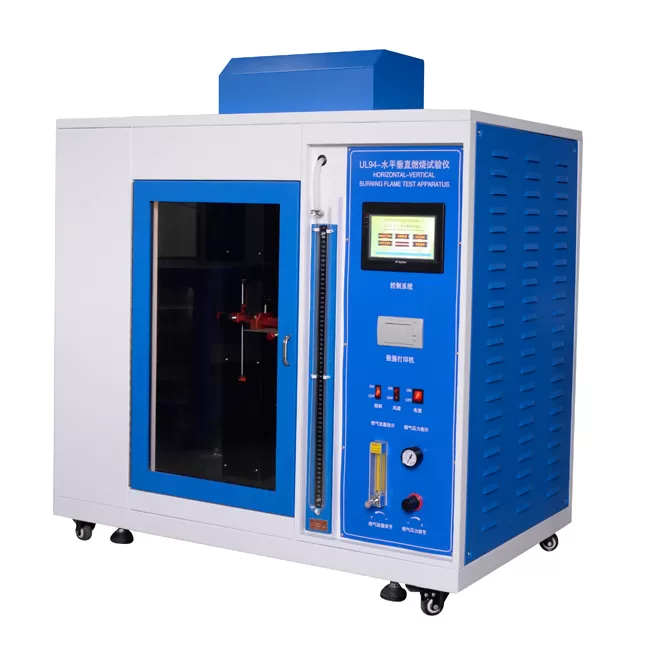
Quantifying how materials behave under direct flame contact, radiant heat flux, and elevated thermal conditions is a non-negotiable requirement across global manufacturing. Polymers, structural composites, commercial textiles, and electronic encapsulants require documented reaction-to-fire characteristics before entering regulated supply chains. Deploying an industrial-grade flammability testing machine provides engineering teams and quality assurance laboratories with empirical data on ignitability, self-extinguishing capabilities, flame propagation rates, and secondary combustion phenomena such as flaming drips or post-ignition char development.
Thermal degradation begins at the chemical bond level, progressing through endothermic decomposition to produce volatile gaseous hydrocarbons. These combustible gases mix with ambient oxygen at the boundary layer, producing a self-sustaining exothermic chain reaction when an ignition source is introduced. Accurately characterizing this progression demands high-precision apparatus designed to isolate variables such as airflow velocity, thermal radiation intensity, exhaust evacuation rates, and gas composition. Navigating these requirements demands a precise technical understanding of instrument design, standardized test protocols, and operational workflows.
Regulatory Frameworks and Testing Methodologies Governing Reaction to
Fire
Fire test standards do not assess a material under arbitrary conditions; instead, they define reproducible exposures ranging from low-energy Bunsen-style burners to elevated radiant thermal envelopes. Selecting laboratory instrumentation requires strict compatibility with specific standardization regimes established by ISO, ASTM, IEC, and regional safety organizations.
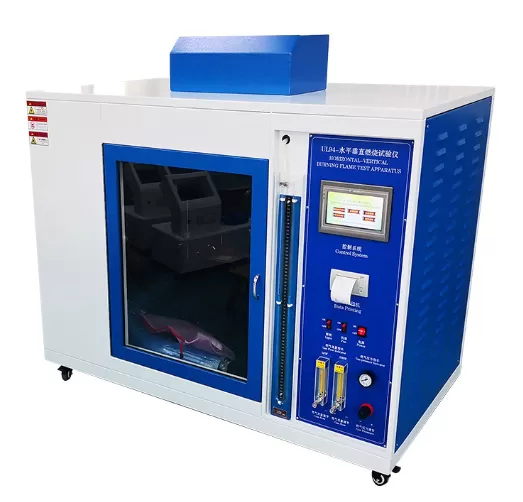
Vertical and Horizontal Bunsen Burner Tests: Governed by UL 94, ASTM D635, ASTM D3801, and IEC 60695-11-10. These methods determine burning rate, afterflame time, afterglow time, and whether molten polymers discharge burning particles capable of igniting surgical cotton situated beneath the specimen holder. Classifications range from HB (slow horizontal burn) through V-2, V-1, and V-0 (self-extinguishing vertical orientations), up to 5VA and 5VB ratings for industrial enclosures.
Oxygen Index Determination: Standardized under ISO 4589-2 and ASTM D2863. This procedure establishes the Limiting Oxygen Index (LOI), which represents the minimum volumetric concentration of oxygen in a blended oxygen-nitrogen stream that supports flaming combustion of a vertically oriented test specimen.
Glow Wire and Hot Wire Ignition: Specified in IEC 60695-2-10 series for consumer electronics and domestic appliances. These tests simulate thermal stresses produced by malfunctioning electrical components, overloaded circuits, or glowing electrical contacts using an electrically heated nickel-chromium loop clamped against the test sample at temperatures up to 960 degrees Celsius.
Heat Release and Mass Loss Rate: Benchmarked through oxygen consumption calorimetry via ASTM E1354 and ISO 5660-1 (Cone Calorimeter). These standards quantify Peak Heat Release Rate (pHRR), Total Heat Release (THR), effective heat of combustion, and dynamic mass loss rate under uniform, user-specified external radiant heat fluxes reaching up to 100 kW per square meter.
Core Engineering Principles Behind a Modern Flammability Testing Machine
Every operational flammability testing machine relies on an integrated assembly of fluid controls, thermal barriers, structural mechanics, and digital telemetry to guarantee measurement repeatability across hundreds of test cycles.
Chamber Design and Thermal Boundary Integrity
The interior test enclosure must be fabricated from high-grade, corrosion-resistant austenitic stainless steel, typically AISI 304 or 316, or lined with non-combustible, asbestos-free insulation boards capable of withstanding repetitive thermal cycling. Natural draft or mechanically regulated ventilation systems ensure that ambient air delivers adequate stoichiometric oxygen to the combustion envelope without introducing micro-drafts that perturb the laminar profile of the application burner. Tempered, heat-resistant observation windows constructed from borosilicate glass allow operators to monitor flame spread and dripping events safely without disturbing chamber pressure or internal draft equilibria.
Burner Positioning, Actuation, and Gas Flow Dynamics
Precision flame application demands controlled exposure intervals down to the millisecond. Automated ignition systems drive certified Tirrill or Bunsen burners using motorized linear guide rails or pneumatic cylinders, ensuring zero manual variance during burner approach, dwell time, and withdrawal phases. The gas delivery train integrates digital mass flow controllers (MFCs) alongside needle valves to govern incoming fuel purity and flow velocity. Whether using methane, propane, or technical-grade butane, fuel flow rates must adhere strictly to standard-defined thermal output envelopes—typically verified by measuring the time required for a calibrated electrolytic copper block to heat through a defined temperature window.
Data Acquisition, Heat Flux Sensing, and Specimen Loading
Advanced flammability testing rigs integrate thermopiles, high-resolution load cells, and water-cooled Schmidt-Boelter or Gardon-type heat flux gauges. When testing specimens in horizontal, vertical, or angled orientations, specialized pneumatic or screw-clamped jigs must securely restrain the substrate to avoid thermal warping, edge-curling, or unrepresentative premature structural collapse. Signal conditioning units digitize microvolt outputs from thermocouples positioned within the flame zone or exhaust plume, channeling high-frequency data streams into acquisition software for real-time visualization and reporting.
Material Pyrolysis Dynamics Across Industry Sectors
Fire risks manifest differently depending on polymer chemistry, cellular structure, physical geometry, and end-use environments. Evaluating testing machinery requires an understanding of how distinct classes of materials decompose under flame exposure.
Structural Thermoplastics and Engineering Resins: Polyamides (PA), polycarbonates (PC), and polybutylene terephthalate (PBT) used in automotive connectors and switchgear undergo thermal chain-scission. The presence of halogenated or phosphorus-based flame retardants stimulates vapor-phase radical quenching or promotes condensed-phase char forming. Instrumentation must capture afterflame intervals precisely to classify self-extinguishment.
Flexible and Rigid Cellular Plastics: Polyurethane and polystyrene foams frequently collapse, liquefy, or undergo severe volume retraction when exposed to heat sources. Testing these substrates per ASTM D3574 or ISO 3582 necessitates chambers that accommodate rapid smoke generation while preventing flame propagation along melted internal substrates.
Industrial and Transportation Textiles: Upholstery, geotextiles, and aviation cab interiors require both vertical strip flammability tests and 45-degree angle evaluations. Edge burning versus surface burning, fabric melting, and glowing smolder behavior demand optical sensors or mechanical tripwires linked directly to digital timers.
Wire, Cable, and Conduit Materials: Halogen-free flame retardant (HFFR) jackets and fluoropolymer insulation require vertical tray test rigs (e.g., IEC 60332 series). These assessments demand massive extraction capacity to handle substantial effluent generation alongside precise thermocouples arrayed over three-meter vertical risers.
Technical Procurement Parameters for Quality Assurance and Testing Laboratories
Specifying the appropriate flammability testing machine requires aligning thermal exposure limits, automated diagnostics, and laboratory infrastructure with long-term throughput expectations. Engineering teams at HAOEN collaborate with laboratory managers during the procurement phase to align specific chamber configurations with target operational workflows.
Gas Train Calibration and Burner Integrity
Procurement teams should verify that burner assemblies conform to internal diameter, tube length, and flame stabilizer tolerances outlined in international standards. Mass flow meters must possess current National Metrology Institute (NMI) traceable calibration certificates. Dual-stage regulators combined with differential pressure transmitters are strongly recommended to prevent flame distortion resulting from facility supply line fluctuations.
Mechanical Repeatability and Automation
Manual positioning introduces operator-dependent anomalies into flame application angles, dwell times, and withdrawal vectors. Prioritize systems featuring programmable logic controllers (PLCs) interfaced with industrial touchscreens. Actuators should deliver positioning accuracy within fractions of a millimeter, while internal timers must operate at millisecond resolutions with documented low-latency triggering.
Exhaust and Thermal Plume Management
Chamber volume and volumetric extraction rates must balance two opposing parameters: the complete removal of toxic combustion products (such as carbon monoxide, hydrochloric acid, and hydrogen cyanide) versus the preservation of quiescent internal airflow conditions during active combustion. Static pressure taps and internal anemometer integration guarantee compliance with international requirements governing chamber drafts.
Installation, Commissioning, and Environmental Controls
The operational environment where fire performance apparatus resides directly dictates test fidelity. Ambient draft variations, laboratory temperature shifts, and humidity variations alter ignition dynamics.
Ambient Drafting and Fume Extraction: Test chambers should not be installed directly beneath building HVAC diffusers or adjacent to high-traffic personnel corridors. Exhaust hoods installed above the chamber must operate with damper-regulated velocities, providing negative extraction draft only during the post-test purging phase, unless a continuous, regulated flow is mandated by specific protocols like cone calorimetry. Equipment providers like HAOEN emphasize duct velocity control to avoid disrupting flame geometry during active measurements.
Gas Quality and Storage Infrastructure: Gas tanks must be stored in compliance with local fire safety ordinances, piped to the apparatus via cleaned, degreased seamless copper or stainless steel tubing. Industrial-grade fuels often contain varying ratios of heavier hydrocarbon condensates; certified technical purity (minimum 99.5% for methane or propane) is required to eliminate variations in net heat release and stoichiometric flame temperature.
Specimen Pre-Conditioning Protocol: Thermophysical testing is invalid without rigorous sample conditioning. Materials must reside in controlled environmental chambers at 23 degrees Celsius (±2°C) and 50% relative humidity (±5% RH) for periods typically ranging from 48 to 168 hours before mounting. Failure to condition specimens directly compromises test comparability by altering internal moisture equilibrium.
Mitigating Drift and Managing Operational Integrity Over Extended Lifecycles
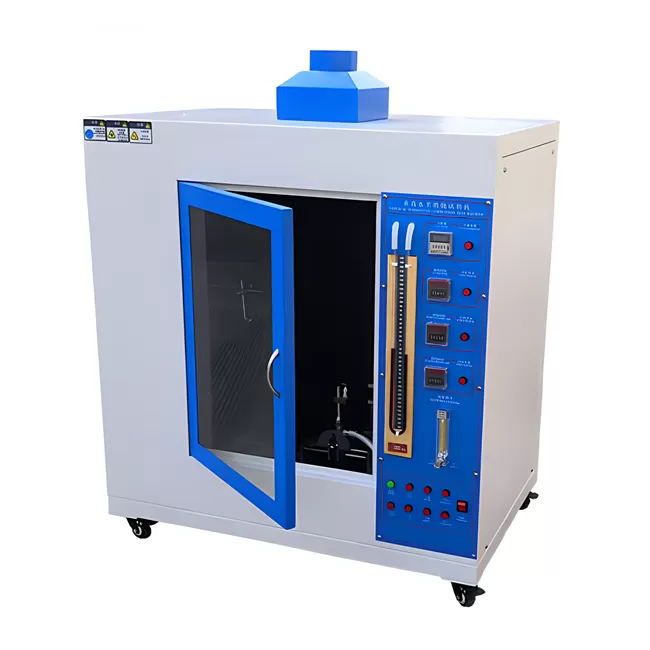
High thermal cycles, soot deposition, and corrosive off-gassing create severe wear profiles within combustion chambers. The operational drift of a flammability testing machine often originates from subtle changes within the burner orifice or degraded heat-sensing optics rather than catastrophic electrical failure.
Flame validation must occur at standardized operating intervals. Burner thermal output is routinely checked using copper block calorimetry, where the time taken for the metal core to heat from 100 degrees Celsius to 700 degrees Celsius confirms that flame energy remains within specified boundaries. Accumulations of carbon soot inside the burner tube or on the burner mesh must be cleared using ultrasonic solvent baths rather than aggressive mechanical reaming, which alters critical orifice dimensions and disrupts laminar flow conditions.
Sensors deployed in dynamic combustion zones require frequent zero-point and span checks. Thermocouples oxidize, drift, and eventually become embrittled; they should be cataloged and swapped according to operational hour limits rather than awaiting physical failure. Exhaust filtration trains—including HEPA, activated carbon, and particulate coalescing filters—must undergo daily inspections to prevent backpressure spikes from altering drafting characteristics inside the burn chamber.
Frequently Asked Questions
Q1: What is the primary operational difference between UL 94
horizontal and vertical burning tests?
A1: The horizontal test (HB)
evaluates the linear burning rate of a specimen clamped horizontally at one end
with the flame applied to the free end. It serves as an indicator of general
combustibility. The vertical test (V-0, V-1, V-2) subjects a vertically
suspended material to two successive flame applications at the bottom edge.
Vertical testing is substantially more severe because convection drives thermal
energy and pyrolyzed gases up the unburned length of the sample, while
simultaneously evaluating flaming drips that might ignite a cotton indicator
positioned below.
Q2: How does a flammability testing machine handle corrosive
off-gasses generated by halogenated polymers?
A2: Halogenated
compounds such as PVC or brominated additives release hydrogen chloride or
hydrogen bromide upon decomposition. These gases react with atmospheric moisture
to form aggressive acids. Industrial chambers prevent corrosion by employing
electropolished 316-grade stainless steel interiors, PTFE seals, gold-plated
internal electrical connectors, and accelerated post-test purge cycles that pull
acidic vapor through neutralizer scrubbers.
Q3: Can a single apparatus execute multiple flammability testing
standards?
A3: Universal chambers exist that accommodate multiple
standards through modular burner kits, interchangeable specimen holders, and
configurable flow control software. For example, a single chamber can often be
configured for both UL 94 and IEC 60695-11 vertical/horizontal modes. However,
radically distinct methodologies—such as the Limiting Oxygen Index (LOI) or Cone
Calorimetry—rely on fundamentally unique chamber geometries and measurement
physics, requiring dedicated stand-alone instruments.
Q4: Why is methane purity critical during standardized burner
calibration?
A4: Commercial-grade natural gas contains variable
fractions of ethane, propane, butane, and inert gases like nitrogen or carbon
dioxide. These variations alter the flame speed, adiabatic flame temperature,
and emissivity of the reaction envelope. Standardized tests require methane of
at least 98% to 99% purity to ensure that the heat flux delivered to the
specimen precisely mirrors values established across international testing
networks.
Q5: How frequently does a standard flammability testing machine
require calibration?
A5: Mechanical and electrical
verification—including load cells, automated timers, and mass flow
controllers—typically requires accredited annual calibration. Flame temperature
validation using copper slug calorimetry should be conducted at the start of any
testing campaign, after changing fuel cylinders, or at minimum once per week
during sustained laboratory operations to verify mechanical and burner
consistency.
Advanced Material Testing Rigs and Technical Support
Ensuring compliance with rigorous international safety directives demands testing infrastructure engineered for operational stability, metrological traceability, and complete user safety. Contact HAOEN technical services for bespoke testing rigs, apparatus calibration, and global laboratory engineering support.
Inquire directly with our application engineering group: 13631787342 @163.com