
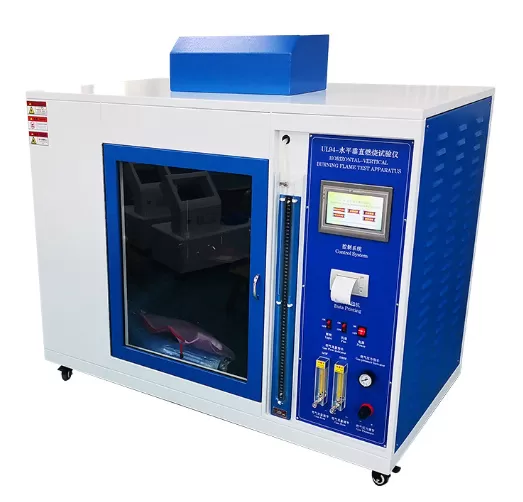
Polymeric formulations, textile composites, and electrical enclosures undergo intense thermal stress in real-world applications. When organic polymers encounter an ignition source, heat initiates an irreversible cascade of pyrolysis, producing volatile gases, char, and reactive free radicals. Quantifying this behavior requires exact environmental isolation, reproducible ignition energy, and high-precision temporal tracking. The flammability test chamber serves as the primary instrument for standardizing these physical phenomena, translating chaotic combustion events into empirical, repeatable data points.
Deploying reliable bench-scale fire testing requires an understanding of thermodynamics, fluid dynamics, and international test standards. Materials that exhibit self-extinguishing behavior under ambient laboratory conditions can demonstrate rapid flame propagation when exposed to controlled thermal fluxes or altered ventilation paths. Consequently, testing hardware must isolate the specimen from uncontrolled air currents, regulate fuel-to-air ratios with absolute fidelity, and ensure that physical degradation does not skew the resulting metrics.
Thermodynamics of Flame Propagation and Material Thermal Degradation
Solid-phase combustion begins when external thermal energy exceeds the dissociation energy of covalent bonds within the polymer backbone. As the surface temperature rises past the decomposition threshold, the polymer breaks down into lower molecular weight fragments. These combustible volatiles escape into the boundary layer directly above the specimen surface, mixing with atmospheric oxygen. Once this gas mixture reaches its flammability limit and ignition temperature, combustion initiates in the gas phase.
The flammability test chamber evaluates materials across distinct stages of this progression:
Ignition Latency: The exact duration of flame exposure required to generate an autonomous, self-sustaining gas-phase flame.
Linear Burn Rate: The horizontal or vertical progression speed of the flame front along the specimen surface, typically measured in millimeters per minute.
Afterflame Time (t1 and t2): The duration over which the material continues to support flaming combustion after the primary ignition source has been retracted.
Afterglow Time (t3): The period of flameless, glowing combustion sustained within the carbonaceous char layer via solid-phase oxidation.
Dripping Phenomena: The separation of molten, flaming droplets capable of igniting secondary substrates placed beneath the primary burn zone.
Managing these variables depends on maintaining stable atmospheric oxygen levels throughout the burn phase. A properly calibrated combustion enclosure maintains sufficient air volume to prevent oxygen starvation while precluding forced convection currents that accelerate heat dissipation away from the flame zone.
Global Regulatory Protocols and Test Standards
Standardized methodologies dictate mechanical configurations, burner geometries, and data capture criteria. Different industries demand distinct combustion orientations, reflecting the orientation of components in their final operational environments.
UL 94: Standard for Tests for Flammability of Plastic Materials
UL 94 defines the industry benchmark for devices and appliances. The standard outlines horizontal burning (HB) and vertical burning (V-0, V-1, V-2) classifications, with higher-tier tests utilizing the 5V (5VA, 5VB) protocols. In a vertical configuration, a calibrated Bunsen burner introduces a standardized methane flame (typically 20 mm to 125 mm height) to the bottom edge of a bar specimen for specified intervals, such as two 10-second applications. Classification rests not only on the flame extinguishing time but also on whether burning particulates ignite surgical cotton positioned 300 mm below the clamp.
IEC 60695 Series: Fire Hazard Testing for Electrotechnical Products
Governing electronics, consumer goods, and electrical switchgear, IEC 60695 evaluates how components react to thermal stresses mimicking electrical faults. Methods include the Needle Flame Test (IEC 60695-11-5), which simulates localized micro-flames originating from overheated traces or PCB components, and the Glow-Wire Test (IEC 60695-2-10 to 13), where an electrically heated nickel-chromium loop applies direct conductive heat to assess flammability and ignition indices without open flame exposure.
Automotive and Transportation Mandates (FMVSS 302 / ISO 3795)
Automotive interior materials undergo horizontal combustion assessments via Federal Motor Vehicle Safety Standard 302 and its international equivalent, ISO 3795. These protocols evaluate the burn velocity of polymers, textiles, composites, and trim parts. Specimens are secured inside a U-shaped frame within a specialized horizontal combustion chamber, tracking whether the material self-extinguishes before reaching the first timing mark, or calculating the burning rate over a defined 254 mm gauge length.
Aerospace and Mass Transit Standards (FAR 25.853 and EN 45545-2)
Commercial aircraft cabins and railway interiors are subject to vertical, horizontal, and 45-degree/60-degree burn tests. These tests feature stricter parameters regarding heat release, optical smoke density, and toxic gas generation. FAR 25.853 enforces precise timing of flame exposure and short afterflame allowances to prevent rapid passenger compartment flashover.
Critical Hardware Subsystems in a Flammability Test Chamber
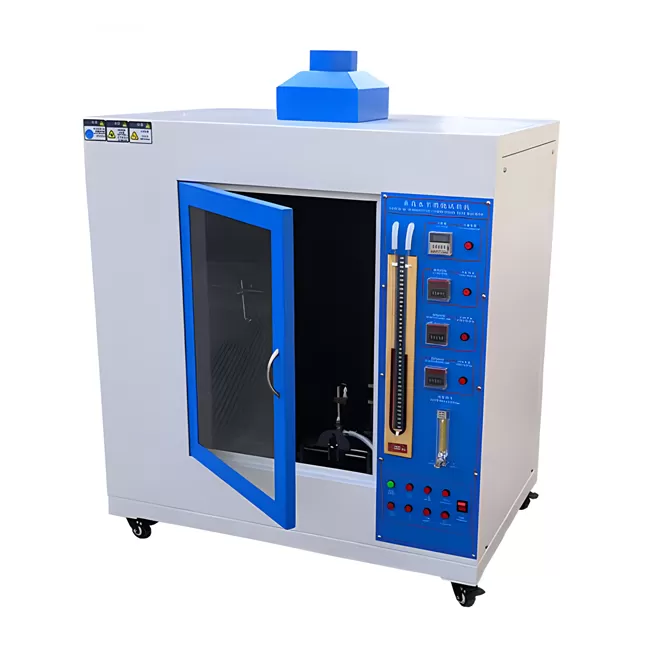
Replicating precise regulatory environments requires specialized mechanical, pneumatic, and electronic integration. A modern flammability test chamber balances internal atmosphere stability with operator safety and process control.
Chamber Aerodynamics and Draft Elimination
The primary structural enclosure must isolate the testing area from laboratory air currents. According to standards such as ASTM D5025 and IEC 60695-11-10, ambient air velocities inside the chamber around the test specimen must remain below 0.2 m/s to prevent unnatural convective cooling of the flame envelope. Hardware architectures engineered by HAOEN incorporate internal chamber volumes of at least 0.5 to 0.75 cubic meters. This space provides adequate internal oxygen so the combustion reaction does not alter its kinetics through self-induced starvation before the test completes.
Burner Positioning and Gas Distribution Networks
Burner geometry is strictly standardized. Typical configurations call for an internal barrel diameter of 9.5 mm ± 0.3 mm and a barrel length of approximately 100 mm. The assembly must feature precision angle adjustment mechanisms, transitioning from 0 degrees (vertical) to 20 or 45 degrees relative to the vertical plane. Industrial-grade gas delivery systems utilize high-purity methane (minimum 99.0% to 99.5% purity) regulated through dual-stage pressure regulators and mass flow controllers to deliver an exact heat output, typically calibrated to 50 W or 500 W via copper block temperature rise calibrations.
Exhaust and Post-Test Scrubbing
Polymer combustion liberates dense particulate matter, halogenated compounds, and acidic vapors. An operational chamber integrates a sealed exhaust damper system. During testing, this damper remains closed to preserve a completely draft-free environment. Upon test completion, an automated mechanical extraction fan purges the chamber volume through dedicated laboratory exhaust ducting, removing harmful effluents before the operator opens the access doors.
Specimen Preparation Protocols and Operational Repeatability
Discrepancies in fire test data often trace back to improper specimen preparation rather than hardware drift. Testing polymers demands strict adherence to dimensional tolerances, surface conditioning, and edge treatments.
Specimens must be molded or machined to standardized dimensions. In UL 94 vertical testing, typical dimensions are 125 mm ± 5 mm in length, 13.0 mm ± 0.5 mm in width, and the target application thickness, which often ranges from 0.4 mm up to 3.0 mm. Specimen thickness dictates the thermal inertia of the sample: thinner samples heat up rapidly, leading to accelerated pyrolysis, while thicker specimens exhibit higher conductive heat loss through the solid phase.
Conditioning specimens standardizes moisture equilibrium within the polymer matrix. High moisture absorption can act as a heat sink, artificially lowering burn rates and increasing self-extinguishing tendencies. Standard conditioning cycles demand:
Standard atmospheric storage: 48 hours at 23°C ± 2°C and 50% ± 5% relative humidity.
Accelerated thermal aging: 168 hours at 70°C ± 2°C followed by cooling in a desiccator over anhydrous calcium chloride for at least 4 hours.
Evaluating edge conditions is equally critical. Machined specimens often retain micro-burrs and surface fissures that serve as localized hot spots, lowering the apparent ignition threshold. Specimens must be deburred and visually inspected before mounting into the sample clamps.
Overcoming Technical Bottlenecks in Flammability Testing
Securing reproducible test results requires addressing several persistent operational challenges. Minor physical changes in the burner path or ambient environmental variations can skew critical pass/fail classifications.
Accurate flame verification requires empirical confirmation beyond visual flame height. Standardized copper block calibration protocols solve this issue. A specified 10-gram or 100-gram electrolytic copper slug equipped with an embedded Type K thermocouple is placed above the burner. The time required for the slug temperature to increase from 100°C to 700°C must fall within precise microsecond-level tolerances. This step validates that the fuel, air pressure, and gas velocity yield the correct thermal flux.
Automated burner transit eliminates timing errors associated with manual burner positioning. Using linear actuators and digital timers ensures that the burner approaches, dwells under the specimen for exactly 10.0 seconds (or the designated standard duration), and retracts at uniform speeds. Advanced equipment solutions from HAOEN employ digital motor controllers that reduce manual positioning variance to less than 0.1 mm, preventing human reaction times from biasing ignition latency measurements.
When working with flame-retardant polymers containing brominated, chlorinated, or phosphorus-based additives, the interior environment of the chamber is subjected to acidic combustion byproducts, such as hydrogen bromide (HBr) and hydrogen chloride (HCl). These gases are highly corrosive to structural metals, electrical relays, and viewing windows. Industrial testing setups counter this issue through the use of 304 or 316-grade stainless steel internal linings, specialized anti-corrosion fluoropolymer coatings, and multi-layer chemically toughened safety glass viewports.
Hardware Selection Criteria for Industrial Laboratories
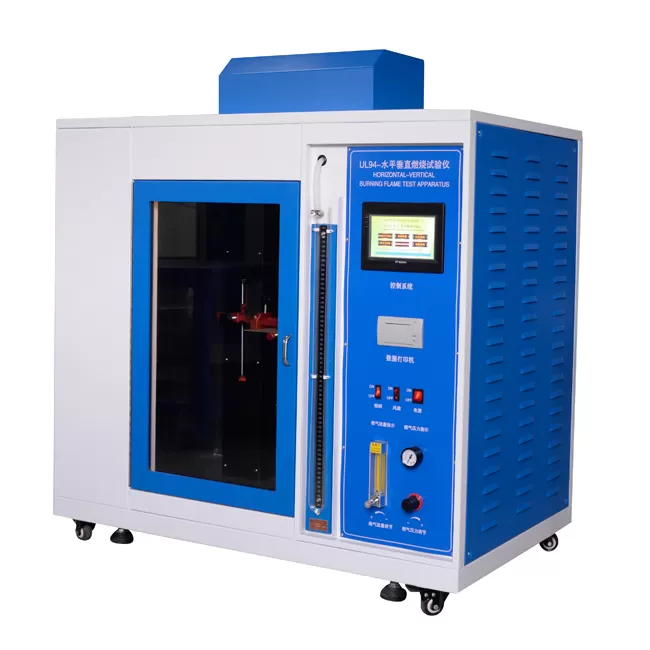
Procuring a flammability test chamber requires aligning hardware features with operational requirements, compliance mandates, and long-term durability. Testing facilities must evaluate potential solutions against specific structural and mechanical benchmarks:
Structural Integrity and Volume: The internal test volume must satisfy the target standard (minimum 0.5 m³ for common standards, 0.75 m³ to 1.0 m³ for high-capacity applications) to avoid oxygen depletion during extensive burn sequences.
Internal Mechanical Automation: Look for multi-axis sample holders and automated burner advance/retraction mechanisms. Chambers equipped with motorized sample stages simplify adjustments for different specimen lengths without requiring the operator to break the thermal seal of the testing chamber.
Sensor Integrity and Data Capture: Modern interfaces should log afterflame, afterglow, linear burn rates, and calibration curves directly to an onboard microprocessor, outputting compliance-ready CSV or PDF reports.
Burner Angle Rigidity: Mechanical locks must hold the burner securely at 0°, 20°, 45°, or 90° angles without slippage under high temperatures.
Safety Interlocks: The system must feature integrated combustible gas leak detectors, flameout detection that shuts off the primary solenoid valve upon unintended loss of flame, and safety door interlocks that prevent gas release when the enclosure door is open.
Investing in reliable test equipment ensures that material classifications stand up to scrutiny by regulatory bodies and quality audits worldwide.
Frequently Asked Questions (FAQ)
What is the primary operational difference between horizontal and vertical flammability tests?
The primary difference lies in the orientation of heat transfer relative to the unburned material. In a horizontal test (such as UL 94 HB or FMVSS 302), the flame burns horizontally across the sample surface, meaning the convective thermal plume rises away from the unburned section, resulting in a slower, more controlled burn rate. In a vertical test (such as UL 94 V-0/V-1/V-2), the flame directly preheats the unburned material located directly above the combustion zone. Vertical tests are significantly more demanding and measure the material's ability to self-extinguish when subjected to upward flame spread dynamics.
Why is methane gas preferred over propane or butane in standard flammability chambers?
Methane is specified across key international benchmarks like UL 94 and ASTM D5025 because it burns with a clean, well-defined thermal output and lower radiant soot emissivity compared to propane or butane. Methane offers a consistent calorific value when purchased at 99.0% or higher purity, ensuring that the flame temperature and heat flux applied to the specimen match standard physical models across different laboratories globally.
How often should a flammability test chamber undergo thermal calibration?
Standard operating procedures recommend verifying gas pressures, flame height, and mechanical alignments before every operational shift. Formal thermal calibration—using a standardized copper calibration block and thermocouple to measure heating rates from 100°C to 700°C—should occur at least once a month under standard testing volumes, or whenever gas cylinders, regulators, or internal burner nozzles are serviced or swapped.
Can a single flammability test chamber support both UL 94 and automotive FMVSS 302 protocols?
Yes, provided the chamber maintains sufficient internal volume and features interchangeable mechanical fixturing. Supporting both standards requires swapping the vertical clamp assembly and cotton tray used in UL 94 with the horizontal, double-clamped U-frame and drip pan specified in FMVSS 302. The gas delivery system must also support the specific burner nozzles, flow rates, and flame height configurations required by each standard.
What causes inconsistent burn test results on identical batches of plastic material?
Inconsistent results typically point to variations in environmental conditioning, improper sample preparation, or ambient drafts within the laboratory. Unequal moisture absorption within hygroscopic plastics (such as polyamides) heavily alters thermal dissipation. Residual internal stresses, thickness variations from poor injection molding, micro-cracks along cut edges, or subtle air drafts above 0.2 m/s inside the chamber during testing will cause deviations in afterflame times and ignition behavior.
Evaluating material fire dynamics requires precise thermal delivery and strictly controlled environment parameters. Advanced testing platforms manufactured by HAOEN offer laboratory-grade mechanical tolerances, automated flame manipulation, and fully compliant enclosure dimensions suited for polymer manufacturers, testing centers, and automotive component labs.
For technical inquiries, configuration options, or to request an instrument quote, contact our engineering team directly: 13631787342 @163.com